CONTENTS
THE CELESTIAL CALENDAR
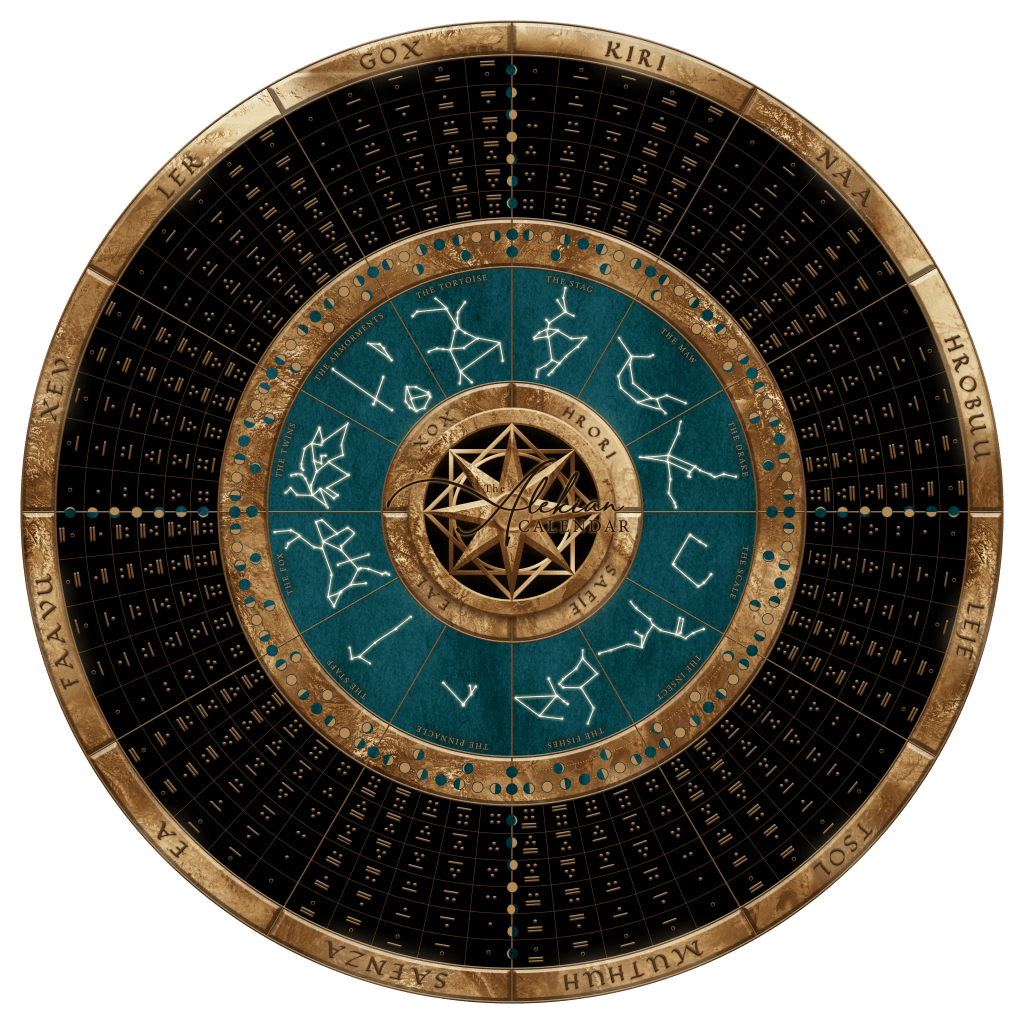
Alékians measure the year as a circle, not a line. To most cultures, the year is not something you leave behind, but something you return to—the same patterns repeating with small differences each turn. For that reason, the Alékian calendar is drawn as a wheel.
An Alékian year contains twelve months. Four seasons complete the cycle, each holding three months. Each month has thirty days, divided into five weeks of six days. By convention, the calendar begins on the winter solstice of the northern hemisphere—the darkest point of their year and the longest day to the southern hemisphere.
The calendar itself is read in concentric rings, from the outside inward:
- The Outer Ring carries the names of the twelve months and is quartered by the solstices and equinoxes.
- The Ring of Days can be viewed as a series of small tables—each counts from day 1 to day 30 of a month. Days proceed from top to bottom before moving to the next column at the turn of each week. This means that the days of the week always line up in horizontal rows.
- In this particular calendar, the lunar phases of Kusfep—Alékia’s largest moon—are illustrated at every solstice and equinox in line with the days of the week. Since a week is based on this moon’s cycle length, and the phases remain consistent for each day in any given week throughout a year, this moon is often omitted in other calendars.
- The Lunar Ring follows, where the remaining two of Alékia’s three moons are tracked.
- Tamwis—often called the ‘Blue Moon’—takes fifteen days, cycling twice per month. It is illustrated on the outer rung of this ring.
- Letoi—usually referred to as the ‘Little Moon’ or the ‘Dark Moon’—moves slowly, completing one cycle every ninety days. It is illustrated on the inner rung of this ring.
- The Stellar Ring shows twelve constellations from the night sky, each linked to a month. Whether these constellations shape fate or simply serve as markers depends on which scholar you ask.
- The Inner Ring lists the names of the four seasons.
- The Center is often left blank, but in this instance is illustrated with a compass rose and a label.
The Alékian wheel doesn’t advance day by day. Instead, the whole circle turns at the close of each week. The topmost section always shows the current week, and after six days, the wheel is rotated six degrees counter-clockwise.
SEASONS & MONTHS
Each season marks more than a shift in weather. Festivals, observances, and even superstitions tie themselves to these divisions. A birth in Kiiridi’makt is often seen as fated for hardship, while those born in Faavudi’makt are thought to be marked by joy. Whether such beliefs hold weight or not, the rhythm of seasons and months shapes nearly every aspect of life in Alékia.
Harror • Season of Stillness
The year begins quietly, at the winter solstice. This season is marked by solemn endurance: the world at rest, the sun weak, and life withdrawn.
- Kiiridi’makt — Month of Death
- Naadi’makt — Month of Darkness
- Hrobuudi’makt — Month of Substance
Saejdi • Season of Renewal
Spring returns with balance at the equinox. Life stirs again, waters rise, and the world begins its slow reawakening.
- Lejedi’makt — Month of Life
- Tsoldi’makt — Month of Sun
- Muthuhdi’makt — Month of Water
Eaeld • Season of Vitality
Summer begins with the second solstice and is the season of strength. The sun is at its height, the air heavy with heat and energy, and the year seems to press forward with urgency.
- Saenzadi’makt — Month of Hope
- Eaedi’makt — Month of Energy
- Faavudi’makt — Month of Jubilee
Zoxak • Season of Passage
Autumn carries the year toward its end, a time of transition and reckoning. This season begins with the final equinox. Harvests are gathered, accounts are balanced, and change is inevitable.
- Xevdi’makt — Month of Creation
- Lekdi’makt — Month of Man
- Goxdi’makt — Month of Destruction
HOLIDAYS & OBSERVANCES
The Alékian calendar is filled with celebrations, festivals, and commemorations, but the most widely observed are tied to the heavens. These celestial holidays are the rhythm by which nearly all peoples reckon their year, regardless of culture or creed. However, they are often celebrated quite differently; cultures of the north and south inversely honor solstices and equinoxes, and non-indigenous races tend to place less importance on lunar events.
Solar Observances
The four great turnings of the sun are honored across Alékia: the solstices and equinoxes. Each marks not only the change of season but a shift in ritual practice for many religions, and a shift in the routine of daily life. These events occur on:
- Winter Solstice — 1st of Kiiriba’makt
- Spring Equinox — 1st of Lejeba’makt
- Summer Solstice — 1st of Saenzaba’makt
- Autumnal Equinox — 1st of Xevdi’makt
Lunar Observances
As there are three, the moons of Alékia govern a greater number of days. Each month carries its own lunar nights and mornings, moments when one or more moons reach an alignment thought to veil or reveal truth. These observances vary. Nights are times of silence, mourning, or shadow. Mornings occur on the following day and are moments of renewal, release, or illumination. The lunar holidays marked on mid-month nights are treated as omens and often inspire local festivals or taboos.
- Night of the Dead — 23rd of Kiiridi’makt
- Morning of the Dead — 24th of Kiiridi’makt
- Moons of Truth — 16th of Naadi’makt
- Night of Substance — 8th of Hrobuudi’makt
- Morning of Substance — 9th of Hrobuudi’makt
- Night of the Living — 23rd of Lejedi’makt
- Morning of the Living — 24th of Lejedi’makt
- Moons of Order — 16th of Tsoldi’makt
- Night of Balance — 8th of Muthuhdi’makt
- Morning of Balance — 9th of Muthuhdi’makt
- Night of the Spirits — 23rd of Saenzadi’makt
- Morning of the Spirits — 24th of Saenzadi’makt
- Moons of Chaos — 16th of Eaedi’makt
- Night of Liberty — 8th of Faavudi’makt
- Morning of Liberty — 9th of Faavudi’makt
- Night of the Creator — 23rd of Xevdi’makt
- Morning of the Creator — 24th of Xevdi’makt
- Moons of Deception — 16th of Lekdi’makt
- Night of the Destroyer — 8th of Goxdi’makt
- Morning of the Destroyer — 9th of Goxdi’makt
Historical Observances
Alongside the heavens, mortals have added their own days: anniversaries of treaties, victories, or independence; fasts recalling great disasters; festivals born of local heroes. These vary widely from place to place, and in many regions, they outnumber the celestial holidays. This record is still incomplete, as each nation and people guard their own histories, and so the calendar is always in the process of being added to.
CONSTELLATIONS OF THE ZODIAC

KIIRI
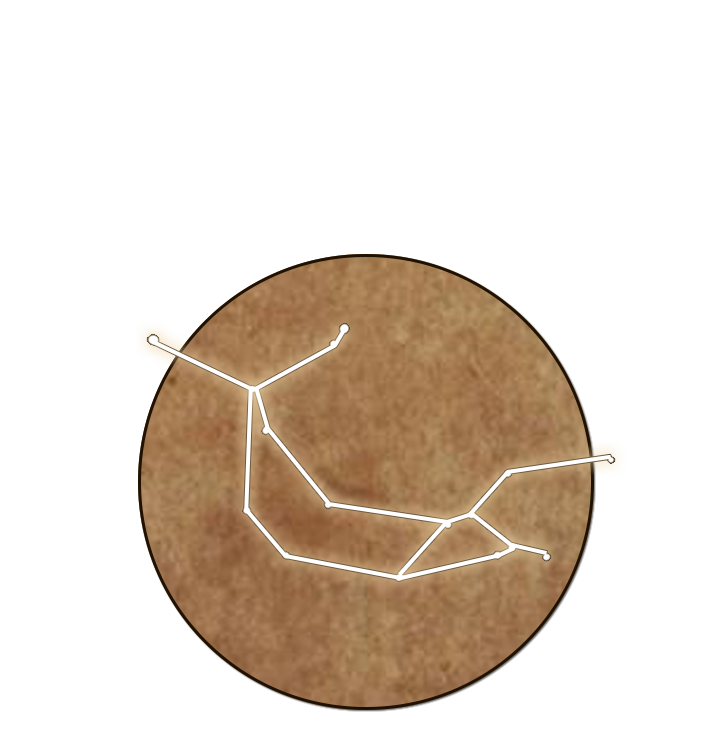
MUHWEA

ALIATH

TAWAZUN

ATHROPLEUR
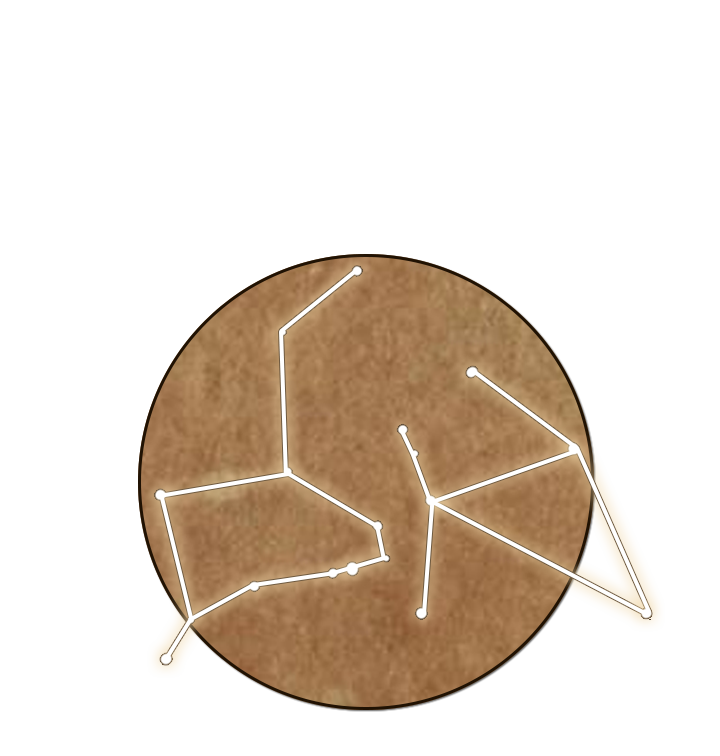
KA I’A & HAHALUA
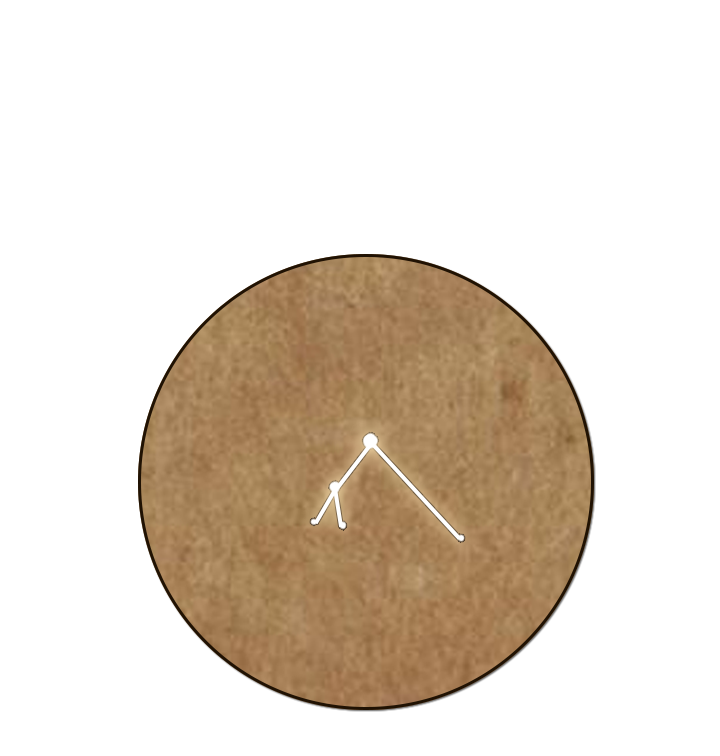
SAAK’AL K’IIN

IICHI’AK TI EA

SAESHEJ

ERSHEJIX & ERSHEJOX

The Party of Three

LEJE
CULTURAL NOTES
Check back later for more…