
CONTENTS

KUSFEP
Rocky Savanna World, named after the Alekian Lesser Deity of Opportunity
“Aside from Ts’ol, I believe Kusfep to be the most glorious object visible in the Alekian Heavens.”
Statistics:
- Distance from Alekia: 0.000886 AU
- Orbital Period: 6 days
- Diameter: 2068 km
- Mass: 4.38 x10²² kg
Body Composition: oxygen, silicon, iron, aluminum, magnesium, and calcium
Atmospheric Composition: nitrogen, oxygen, carbon dioxide, and traces of neon, helium, methane, krypton, hydrogen, and water ice
Overview:
Kusfep has a landscape split between oceanic and continental, where the land consists of dry, arid plains. The moon is comprised of two tectonically overactive plates: one oceanic and one continental. The former encases much of the moon’s northern hemisphere while the latter envelopes the first from the southern hemisphere: much like two halves of a baseball sewn together.
At their plate boundaries, the moon boasts an impressive array of volcanoes- clear evidence of its tectonic vivacity. The largest of these volcanoes was named Charirfla di Hrobuu by famed draco-astronomer Galaxio in 1,656,420 A.C. and is thus the largest continually active volcano known in the Ts’olan System. This over twenty-kilometer tall peak shadows three smaller volcanoes: Charirfla di Arsia, Charirfla di Pavonis, and Charirfla di Ascreus. Though all three are dwarfed by their neighbor to the west, each is larger than any known active Alekian volcano. The only notable exception is the dormant peak Geny Ba’zev, which today hosts the city Eaza Ba’zev in its crater at near fifteen kilometers altitude, but is hypothesized to once have stood two kilometers higher prior to its lateral eruption in 1,647,522 A.C..
Kusfep’s atmosphere is significantly less dense than Alekia’s, but hosts similar composition, being nitrogen based with notable presence of oxygen and carbon-dioxide. This relative thinness allows for brief wet seasons, but aside from a few ubiquitous grasses, vegetation is largely concentrated around shallow oases. Not infrequently, the atmospheric composition congests and shifts as the invariable volcanoes of the moon spew sulfuric materia to the skies.
TAMWIS
Icy Ocean World, named after the Alekian Lesser Deity of Innovation
“A beautiful blue from our surface, but an arctic hellstorm on hers; Tamwis is a cosmic gem best viewed from afar.”
Statistics:
- Distance from Alekia: 0.00167 AU
- Orbital Period: 15 days
- Diameter: 1806 km
- Mass: 2.93 x10²² kg
Body Composition: oxygen, silicon, iron, aluminum, magnesium, and calcium
Atmospheric Composition: nitrogen, oxygen, carbon dioxide, and traces of neon, helium, methane, krypton, hydrogen, and water ice
Overview:
Tamwis is the only known true oceanic world in the Ts’olan System; this is to say the only planetoid where the majority of its surface is composed of liquid water. Oceans cover more than ninety percent of Tamwis, the remaining percentage is divided among the frozen poles, and low altitude archipelagos at equatorial latitudes.
Due to its thick, nitrogen-oxygen atmosphere, much of the moon hovers at or below the freezing point of water. This, in combination with the salinity of Tamwis’ oceans having been confirmed similar to Alekia, lends itself to a daily phenomenon on the planetary body. Each day-night cycle on Tamwis, which is near exact to Alekia’s twenty-four hours, the surface of these oceans has just long enough time to solidify entirely, only to re-thaw in sunlight during its daily Ts’olan exposure. Though predictable, these thawing-freezing cycles are also unrelenting; many exo-explorers have never returned from missions below Tamwis’ waves due to miscalculated return windows, their bodies drifting forever in the hypothesized undercurrents.
Many questions remain unanswered about Tamwis, and due to its proximity, there has been much effort to gain greater understanding of this world. Unfortunately, much has thus come to little discovery. It is still unclear how deep Tamwis’ oceans delve. Indeed it has not even been verified if the moon has planetary crust at all, though its magnetosphere suggest heavily it does have both a liquid mantle and solid, iron-based core.

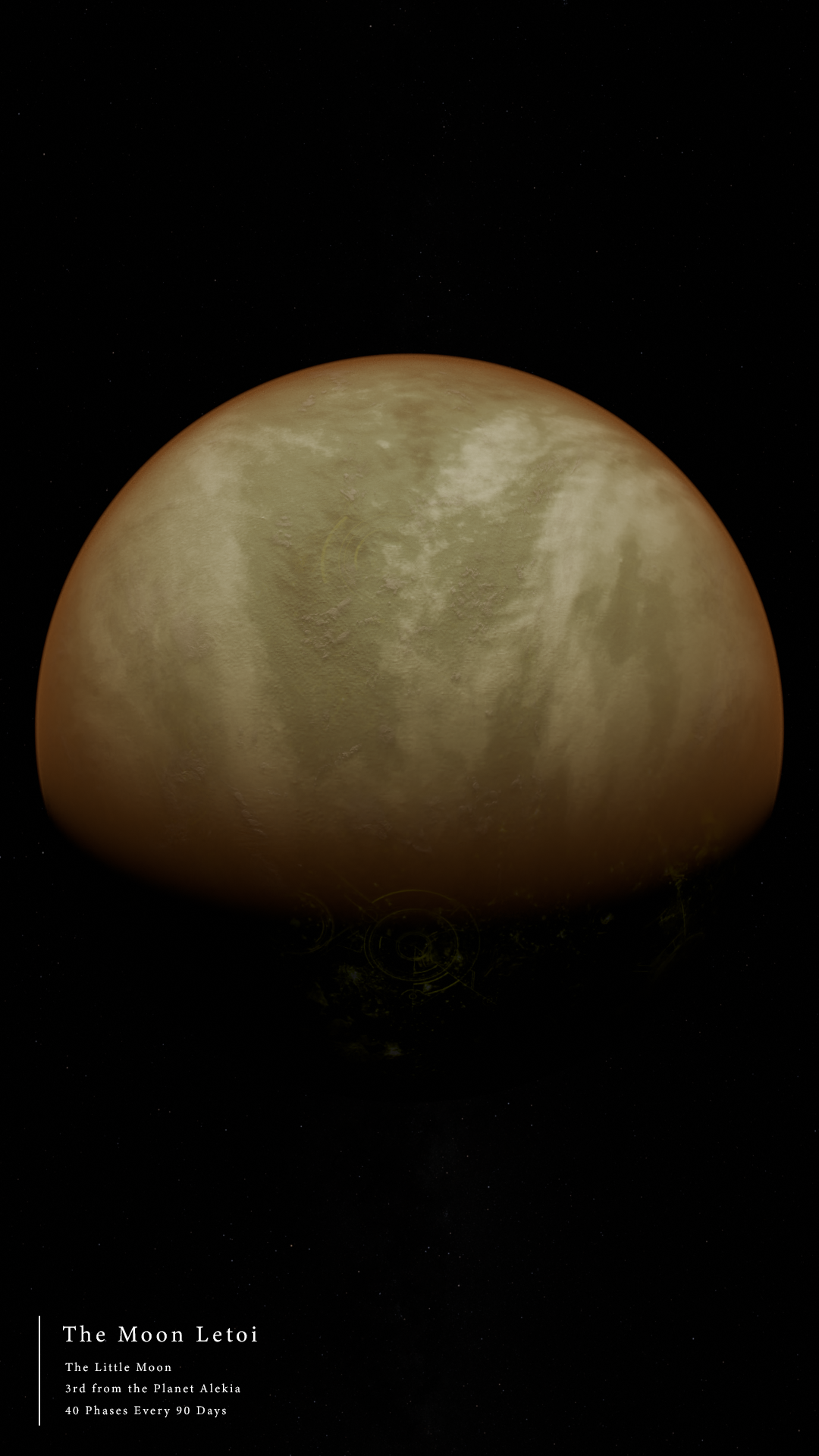
LETOI
Previously a Metallic Relic World, now classified as an Infested Tomb World, named after the Alekian Lesser Deity of Perseverance
“As the smallest and farthest body from Alekia, Letoi is the most mysterious of our moons, and her dense atmosphere doesn’t make discovery any easier.”
Statistics:
- Distance from Alekia: 0.00566 AU
- Orbital Period: 90 days
- Diameter: 1423 km
- Mass: 1.46 x10²² kg
Body Composition: carbon, iron, aluminum, magnesium, zinc, tin, titanium, and traces of osmium, gold, iridium and irisium
Atmospheric Composition: nitrogen, carbon monoxide, and traces of neon, helium, methane, argon, and krypton
Overview:
Officially, Letoi has been classified as a relic world. It displays a confoundingly high metallic composition- particularly of complex, dense metals. It has become apparent the majority of this mass is concentrated in arching megastructures which weave the planetoid’s surface. It is not known how deep these structures extend or if they connect with one another in any way, but it has become abundantly clear they are not naturally occurring.
Curiosity surrounding Letoi and her smoggy appearance peaked in the 1,685,700s as Ts’olan planetary bodies within scrying distance became limited, while demand for discovery still surged among the common people. First to set out for answers were the Giant-kin of Jotun IX. History regards this crew as valiant, though perhaps doomed from the start as they lacked a specialist in divination magic who may have been able to foresee the series of malmagics which ultimately led the team never to arrive on the moon. Five years later, commonfolk demand for exploration remained unfaltering, so in 1,685,777 and again in 1,685,778 the Red Dragon-kin of the Galaxia Disaster and Silver Dragon-kin of the Relekihl Tragedy respectively met similar fates. Public demand was only finally dissuaded in 1,685,780 A.C. with an event known as the Contamination of the Celestia II and the Eek’ M’u’uk’mel in which a joint team of Celestial and Featherfolk exo-explorers mysteriously chose to use their Nasaenza Sequence. This spell is a last-resort, self-disintegrating scroll of wish mandated for all exo-exploration crews under the Alekian Inter-Realm Principals of 1,685,758 A.C. which were intended to maintain the sanctity of Alekia and her biosphere. ‘Nasaenza’ is believed to translate to “No Hope” in High Alekian, and the last team to attempt an expedition to Letoi imploded as the world watched their return.
Since the Moon Rush of the 1,685,700s, none have attempted to return, and as a renowned cosmologist myself I feel it is my responsibility to warn; do not go to this planetoid. Though tempting beyond measure and close as the eye can behold: mysteries which do not wish to be uncovered are not worth dying for.
