
CONTENTS
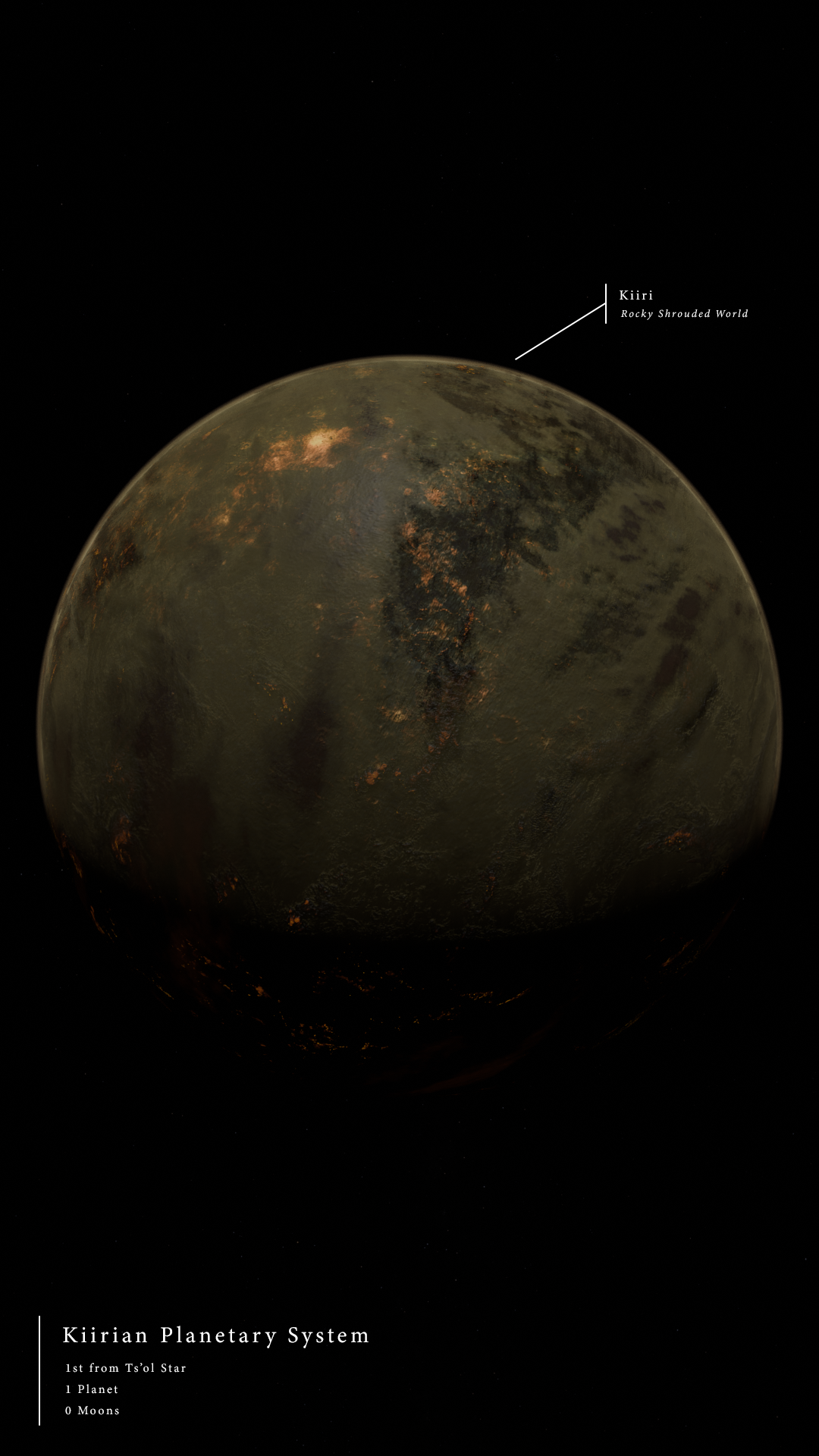
KIIRI
Rocky Shrouded World, named after the Lawful Neutral Alekian Greater Deity of Death
“Our seers are unable to penetrate the thick fog surrounding this planet, and those that enter its atmosphere do not return.”
Statistics:
- Distance from Ts’ol: 0.47 AU
- Orbital Period: 120 days
- Diameter: 4880 km
- Mass: 3.30 ×10²³ kg
Body Composition: iron, oxygen, silicon, magnesium, sulfur, nickel, calcium, aluminum, and sulfur as well as rarer dense metals and metalloids
Atmosphere Composition: atomic oxygen and hydrogen, sodium, magnesium, potassium, calcium, helium, trace amounts of iron, aluminum, argon, dinitrogen, dioxygen, carbon dioxide, water vapor, xenon, krypton, neon
Orbiting Bodies: none
For as close as this planet is to our own, little is known about Kiiri due to its unwelcoming nature. At first glance its features are confusing; a planet in such proximity to its star should not have an atmosphere, yet Kiiri clearly displays one that is not only thick but also distinctly active. It is believed the planet’s ability to retain this odd feature is due in combination to high concentrations of iron particulates and a powerful magnetosphere. This suggests the presence of an overactive mantle, though this theory has thus proven unverifiable by conventional divination or transmutation magic. However it is retained, Kiiri’s atmosphere perpetuates two notably unsettling characteristics. Where clouds are thickest, friction among the iron particles spark and produce distinct orange-umber lightning. And in rare partings where clouds are non existent, tarnished landmasses and ichor oceans peak through. The composition of this latter material is entirely unknown.
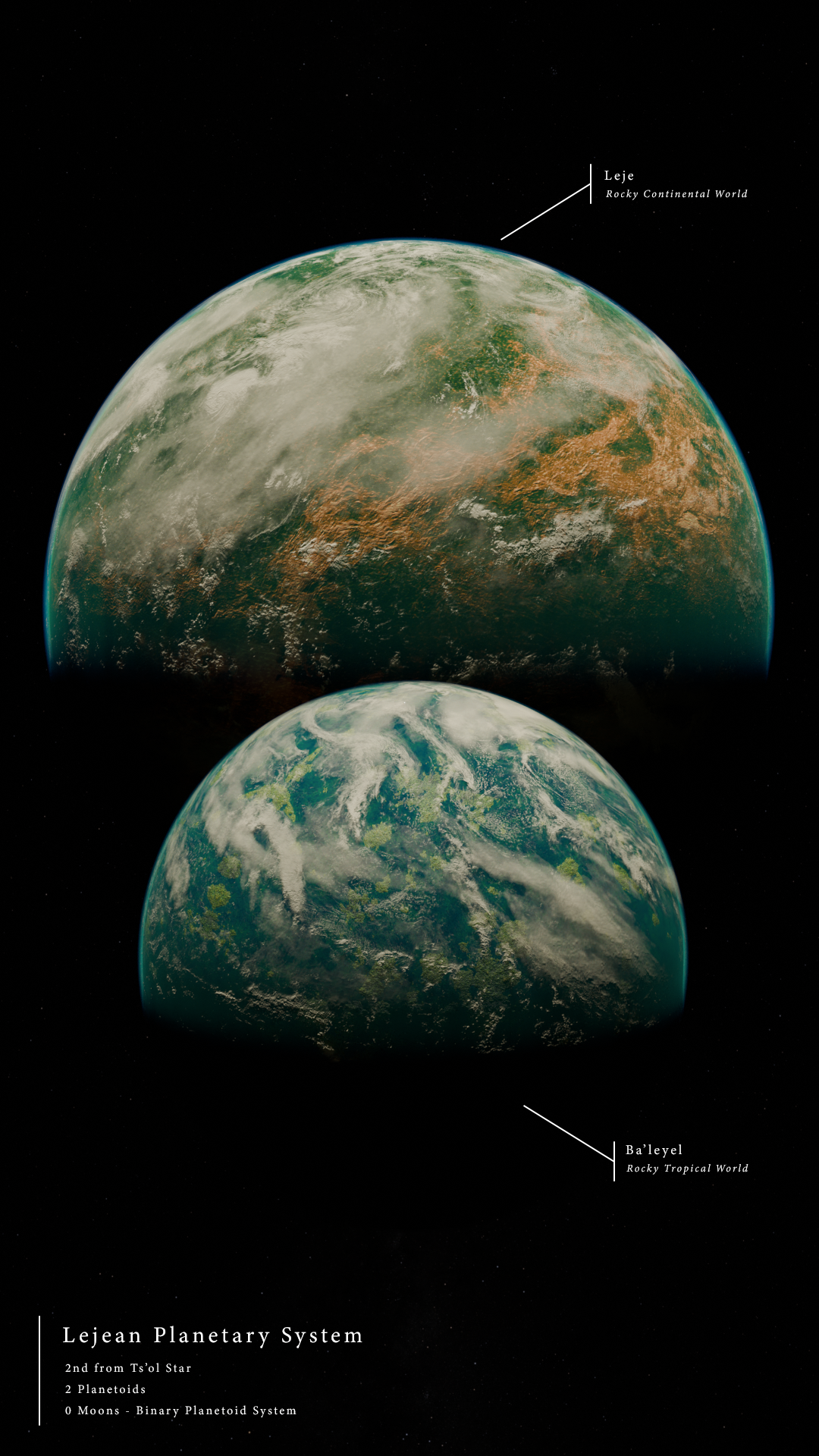
LEJE
Rocky Continental World, named after the True Neutral Alekian Greater Deity of Life
“Leje is a biologically active terrestrial planet, but as far as planets go, it is a quiet and lovely one- as is the second planetary body in the system: Ba’leyel.”
Statistics:
- Distance from Ts’ol: 0.62 AU
- Orbital Period: 180 days
- Diameter: 12104 km
- Mass: 4.87 ×10²⁴ kg
Body Composition: iron, oxygen, silicon, magnesium, sulfur, nickel, calcium, and aluminum
Atmosphere Composition: nitrogen, oxygen, carbon dioxide and monoxide, liquid water, traces of argon, neon, helium, hydrogen, methane, and krypton
Orbiting Bodies:
Ba’leyel: not actually an orbiting body, but rather a co-orbiting body, rocky tropical world, named after the Alekian Intermediate Deity of Knowledge
Overview:
A warm and wet rocky world, Leje has a nitrogen-oxygen atmosphere and stable hydrosphere. Great landmasses sprawl across its surface which alternate hueing the planet a verdant green and shining gold. These continents are separated by broad- though relative to Alekian oceans, shallow -seas, which otherwise render Leje pale blue during certain orbital rotations. It is believed the planet has large climate variations depending on latitude and seasonal precipitation brought by its seventy-seven degree tilt.
Ba’leyel:
Ba’leyel is extremely similar in composition and seasonality to its co-planetary body, Leje, though there are notable differences. Ba’leyel has even shallower seas and is considered to be more humid. Unlike Leje, its continents are interrupted in irregular archipelagos. Seasons are believed to interchange between significant precipitation with slightly drier periods. Like its partnered planetoid, most landmasses are covered in dense vegetation.

ALÉKIA
Coreless Gaia World
“You are here: another pale blue dot in another pitch black universe. Much like the blue dot you are thinking of, this one comes with an abundance of marvelously interconnected creatures and grandiose geologic features. Unlike Terra: Alekia has magic.“
Statistics:
- Distance from Ts’ol: 1 AU
- Orbital Period: 360 days
- Diameter: 12742 km
- Mass: 5.97 ×10²⁴ kg
Body Composition: iron, oxygen, silicon, magnesium, sulfur, nickel, calcium, aluminum, and irisium
Atmosphere Composition: nitrogen, oxygen, carbon dioxide, and traces of neon, helium, methane, krypton, hydrogen, and water ice
Orbiting Bodies: *more on the Alekian moons in the next section
- Kusfep: rocky savanna world, named after the Alekian Lesser Deity of Opportunity
- Tamwis: icy ocean world, named after the Alekian Lesser Deity of Innovation
- Letoi: metallic relic world, named after the Alekian Lesser Deity of Perseverance
Overview:
As the most biologically active and diverse planet in the Ts’olan system, Alekia’s geology and ecology have been extensively studied. Broadly speaking, scholars have divided this home body of Ts’ol into seven mega-biome categories, which are subdivided to biome groups, which are then in turn sub defined as regional geographies. The mega-biomes and their biome groups are:
- Plains, consisting of Grassland, Desert, and Steppe Biomes
- Forests, consisting of Jungle, Temperate, and Taiga Biomes
- Polar, consisting of the Arctic and Antarctic Biomes
- Aerial, consisting of the Troposphere, Stratosphere, and Mesosphere Biomes
- Oceanic, consisting of Pelagic, Bathyal, Abyssal, and Hadal Zones, as well as Lacustrine and Alluvial Biomes
- Rocky, consisting of Mountainous, Subsurface, and Underdark Biomes
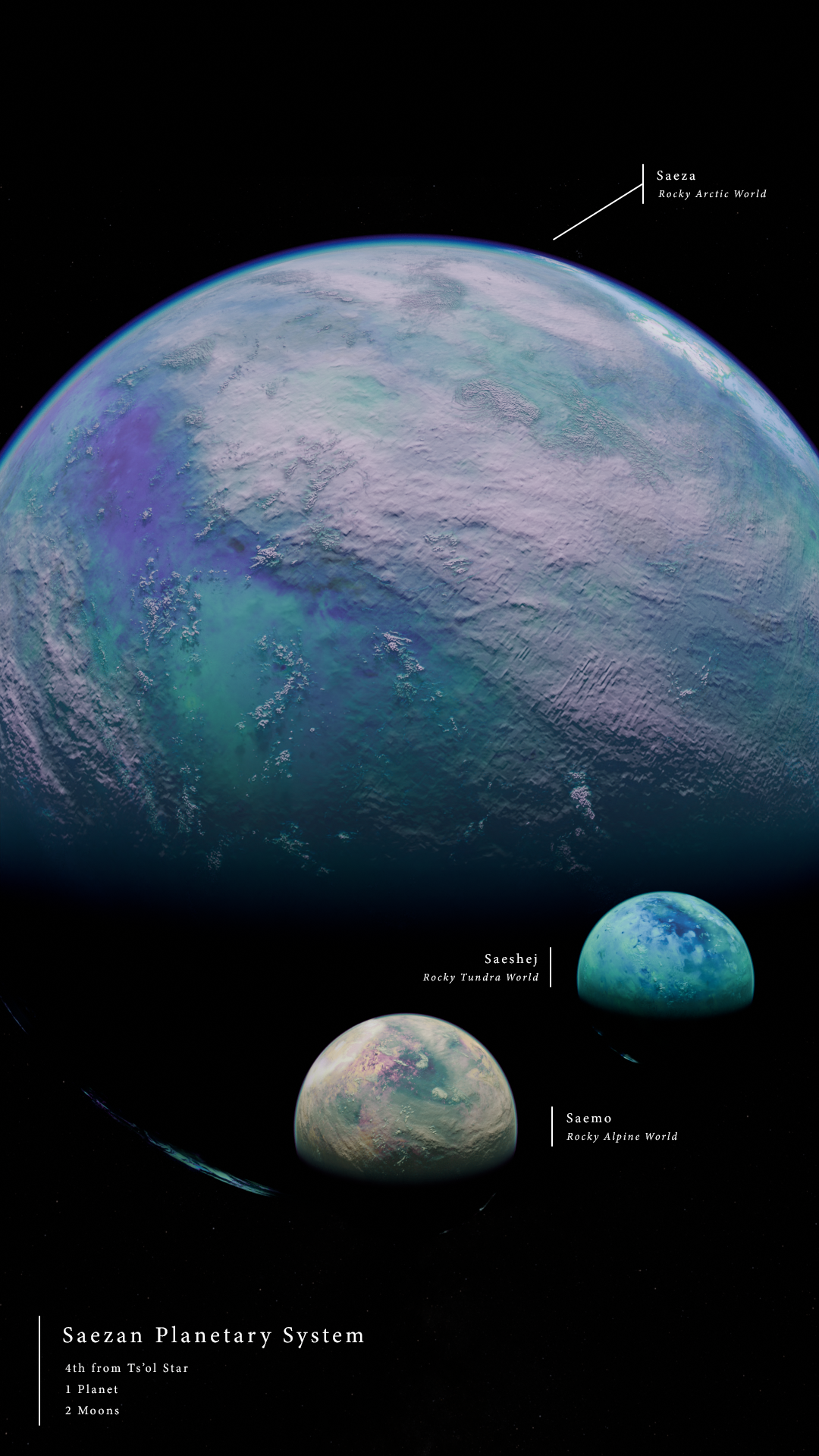
SAEZA
Rocky Arctic World, named after the Chaotic Neutral Alekian Greater Deity of Soul
“To me, Saeza is a planet of pure wonder. From her dazzling colors, baffling auroras, and astounding tandem moons, each time I begin to believe I understand this world, we discover something evermore marvelous.”
Statistics:
- Distance from Ts’ol: 1.57 AU
- Orbital Period: 720 days
- Diameter: 11824 km
- Mass: 4.42 ×10²⁴ kg
Body Composition: iron, oxygen, silicon, magnesium, sulfur, nickel, calcium, and aluminum, unusual overabundance of trace elements cobalt, iodine, and bromine
Atmosphere Composition: carbon dioxide, chlorine, fluorine, argon, nitrogen, oxygen, carbon monoxide, and water ice
Orbiting Bodies:
- Saemo: rocky alpine world, named after the Alekian Lesser Deity of Spirit
- Saeshej: rocky tundra world, named after the Alekian Lesser Deity of Curiosity
Overview:
Saeza is the first of the frigid worlds from the sun and fourth overall in the Ts’olan system. The poles are large, and significant water deposits can be found permanently frozen as glacial ice across most non-equatorial latitudes.
The planet is most known for its rare hues; the surface is calicoed iridescent purple and minty cyan. Clouds accent its blueish, nitrogen-based atmosphere, stretched thin like pink cotton candy by the vast weather systems which buffet the planet’s icy plains. It is believed these rarer colors are due to unexpected levels of cobalt, iodine, and bromine, but the nature of the planet’s winds render sample retrieval extremely challenging.
Saeza is less often known for perhaps an even more beautiful feature: dramatic polar auroras. Though always present at both poles, they can be somewhat elusive. Since Saeza orbits Ts’ol further than Alekia, the light side of the planet- which usually faces us -offers a muted performance. The phenomenon was not known to common folk until it was thoroughly described in 1,658,522 A.C. by notable Athropleurs Exo-Explorer, Wabea the Wanderer.
The final feature worth mentioning pertains to the planetary system rather than Saeza itself: her two moons- of near identical composition and mass -orbit in perfectly opposite tandem to each other. While entirely unobservable to the naked eye from Alekia, this is truly a tangential tango to behold.
FAVU
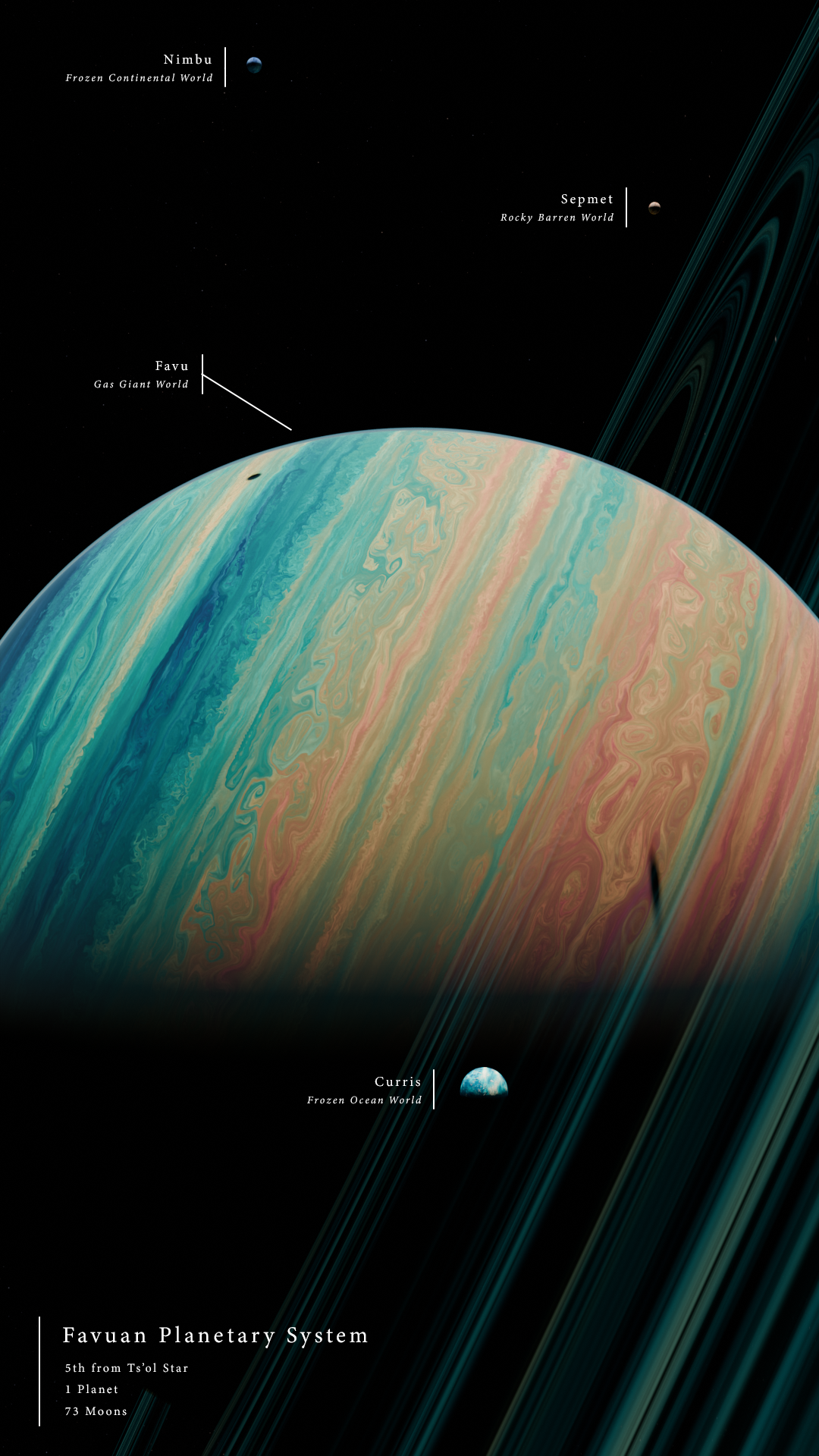
Gas Giant World, named after the Chaotic Good Alekian Greater Deity of Skies
“Ah yes, Favu- that planet so gluttonous for mass it didn’t know what to do with all of it. I would say ‘leave some particles for the rest of us’, but His vastness does defend our fragile terrestrial planets from the Belt.”
Statistics:
- Distance from Ts’ol: 5.20 AU
- Orbital Period: 4330 days
- Diameter: 139822 km
- Mass: 1.88 ×10²⁷ kg
Body Composition: it is believed Favu possesses too much mass at too great a pressure-induced heat to solidify a core or planetary crust
Atmosphere Composition: hydrogen, helium, methane, ammonia, ethane, gaseous water
Orbiting Bodies: (73 Total)
- Curris: frozen ocean world, named after the Alekian Lesser Deity of the Mesosphere
- Nimbu: frozen continental world, named after the Alekian Lesser Deity of the Stratosphere
- Sepmet: rocky barren world, named after the Alekian Lesser Deity of the Troposphere
- and more…
Overview:
Favu is the fifth planet from Ts’ol and- at slightly less than one-thousandth the mass of its star -the largest in the Ts’olan System. It is widely accepted that Favu reached such scales due to it being the first of the planets to form. During this primordial phase, Favu amassed such that combined heat-pressure rendered its materia unable to centrally solidify to a core or mantle. It is believed the planet continues to undergo interior contraction as its mass attempts to conglomerate. This ongoing phase stabilization generates more heat than the planet receives at its 5.2 AU from Ts’ol.
Aside from its vastness, Favu is known for its brilliantly-hued weather systems. Its outer atmosphere is divided into a series of latitudinal bands which churn in ever turbulent storms of blue, yellow, and pink. These exist due to Favu’s rapid rate of rotation: one Favuan Day every twelve Alekian Hours. This rapid rotation additionally changes the planet’s overall shape from a sphere to a distinctly oblate spheroid; this is to say, Favu has a notable bulge around the equator.
The planet is also surrounded by a comparatively non-unsubstantial ring system, which is the second largest contiguous structure in the Ts’olan System after the heliosphere. Among its planetary rings, Favu orchestrates 73 known moons, including its three largest named in 1,658,703 A.C. by notable Aaracokran astronomer, Ka’an Ku Kanáantik: Curris, Nimbu, and Sepmet.
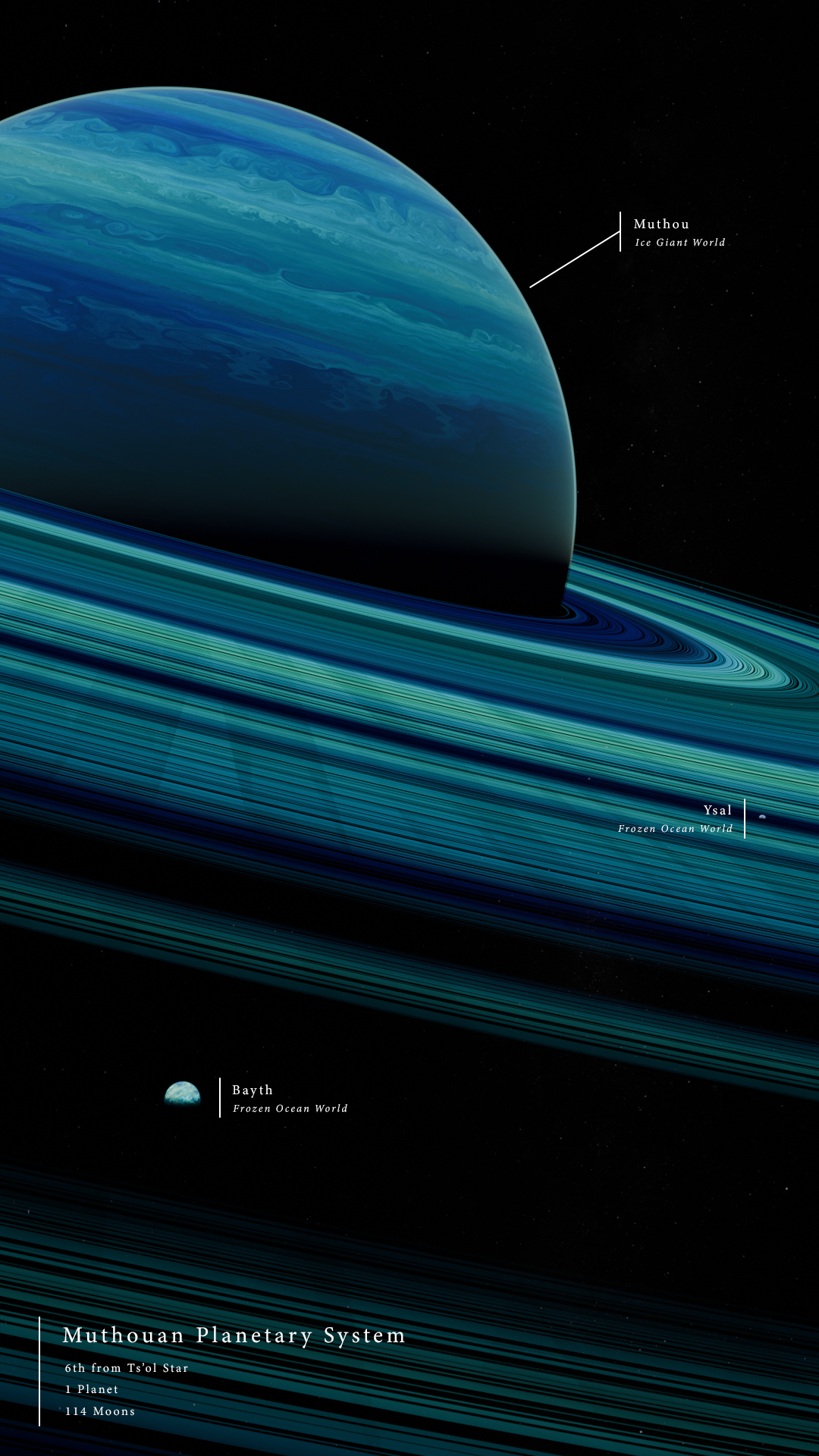
MUTHOU
Gas Giant World, named after the Lawful Chaotic Alekian Greater Deity of Oceans
“Muthou truly beholds her namesake: a perfectly blue balance of cosmic peace and fury. Her lawful order is only apparent in the mean of her chaos.”
Statistics:
- Distance from Ts’ol: 13.1 AU
- Orbital Period: 17280 days
- Diameter: 106464 km
- Mass: 5.68 ×10²⁶ kg
Body Composition: unlike Favu, it is believed this gas giant does possess some form of amalgamated core, though it is unclear if it is of a solid or liquid phase state
Atmosphere Composition: hydrogen, helium, oxygen, and icy volatiles: water ice, ammonia, ammonium hydrosulfide
Orbiting Bodies: (114 Total)
- Bayth: frozen ocean world, named after the Alekian Lesser Deity of Dark Water
- Ysal: frozen ocean world, named after the Alekian Lesser Deity of Trenches
- Pel: frozen ocean world, named after the Alekian Lesser Deity of the Shallows
- Lacu: frozen ocean world, named after the Alekian Lesser Deity of Lakes
- Uvali: frozen ocean world, named after the Alekian Lesser Deity of Rivers
- and more…
Overview:
Muthou is the second of two gas giants of the Ts’olan System- both in its distance from Ts’ol and its size. Its interior is hypothesized to contain a rocky core, surrounded by a deep layer of some yet-to-be-verified liquid hydrogen compound, and a vast atmosphere. This atmosphere, though structurally similar to Favu’s, is chemically unparalleled. It is assumed most blue hues expressed in gas giants originate from methane in their upper atmospheres. However, the deep hue Muthou displays is signature to a different, more perplexing gas: ozone. Some scholars, therefore theorize the majority of the gas giant is composed of concentric layers of variably-phased trioxide.
The planet is most known, however, for its bright and extensive system of rings. These are composed mainly of ice particles, with a smaller amount of rocky debris and dust, which shine with audacious performance. The planet revolves at a near ninety degree obliquity such that every twenty-four Alekian years, when Muthou reaches its bi-yearly solstices, a cosmic event known as the Tides of Muthou occurs. Revered as both a time of prophecy and omens by many Muthouah, Rung, and Scalefolk peoples, the rings refract Ts’ol’s light at such a degree that the planet’s appearance in the Alekian sky quintuples, and the rings can be seen clearly throughout the day.
At least one hundred and fourteen moons orbit Muthou, only ninety-two of which are named; these do not include the hundreds of moonlets in the rings. Bayth is both Muthou’s and the Ts’olan System’s largest moon, and it is larger than Alekia, boasting a similarly extensive atmosphere. Pel, Ysal, and Adal are respectively the next largest of Muthou’s entourage. Thus far, each Muthouan moon appears to share the same perplexing composition of their parent planet.
HROBUU
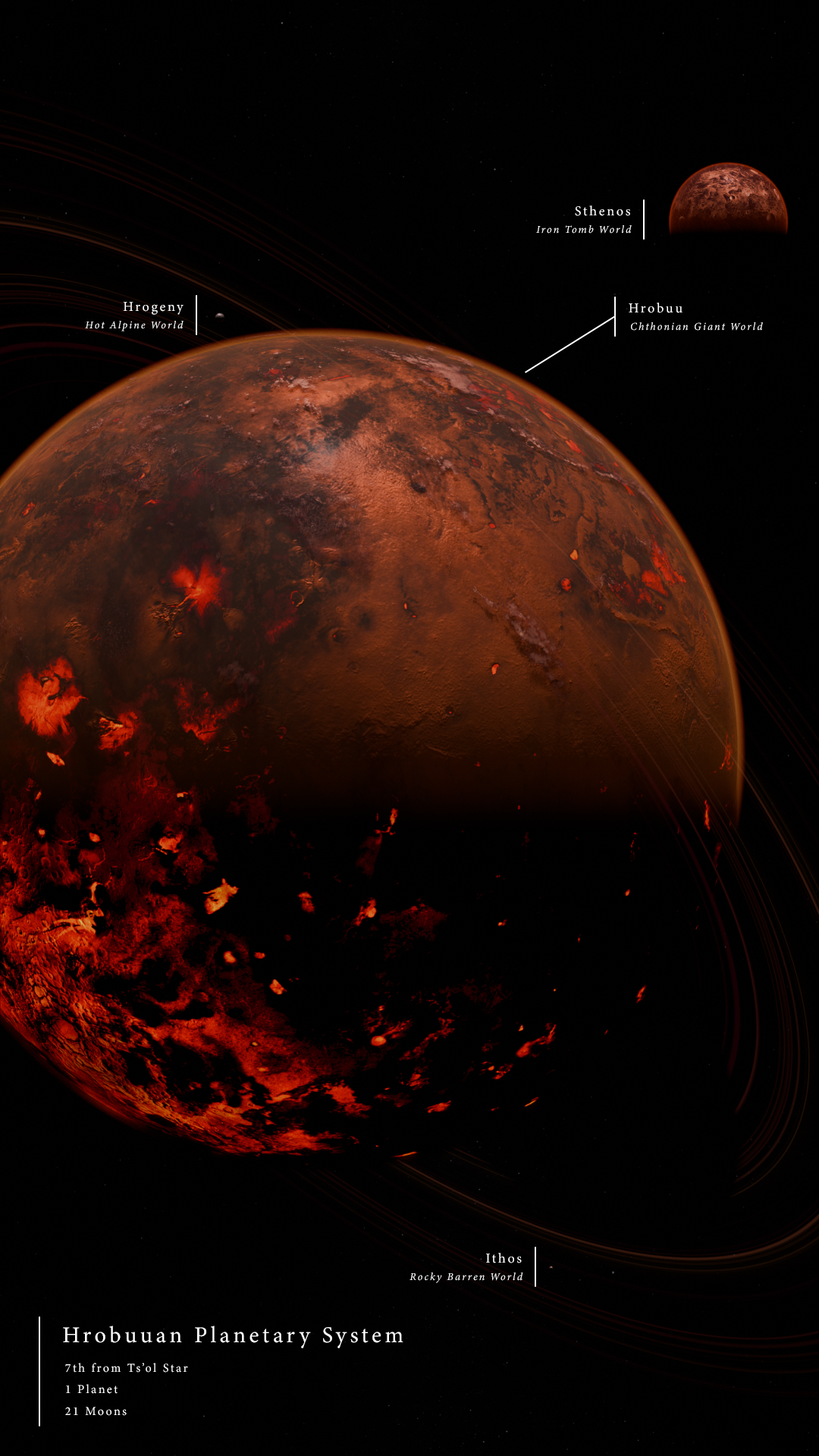
Chthonian Giant World, named after the Chaotic Evil Alekian Greater Deity of Continents
“Hrobuu is considered by many to be an honorary Tenth Layer of Hell- as if honor and infernals have anything to do with one another…”
Statistics:
- Distance from Ts’ol: 20.8 AU
- Orbital Period: 34560 days
- Diameter: 25974 km
- Mass: 2.63 x10²⁵ kg
Body Composition: aluminum, silicon, sulfur, titanium, magnesium, iron, cobalt, copper, and zinc, as well as high concentrations of rare dense metals: lead, osmium, bismuth, and radon
Atmosphere Composition: hydrogen, helium, methane, ethane, and ammonia as well as molten metals and metalloids: magnesium, aluminum, nickel, and iron
Orbiting Bodies: (114 Total)
- Hrogeny: hot alpine world, named after the Alekian Lesser Deity of Mountains
- Sthenos: iron tomb world, named after the Alekian Lesser Deity of Cores
- Ithos: rocky barren world, named after the Alekian Lesser Deity of Caves
- and more…
Overview:
Although all three outer planets live up to their respective namesakes, perhaps none do more violently than Hrobuu. It is officially classified as a chthonian planet: a celestial object resulting from the stripping away of a gas giant’s outer layers in a process referred to as hydrodynamic escape. Usually, such atmospheric stripping is the result of a gaseous planet’s close proximity to its host star. The process of being exposed to such stellar fluxes removes atmospheric mass by photoevaporation and leaves behind a rocky core. These cores often resemble terrestrial planets in many respects, but are typically denser. However, at beyond twenty Alekian Units from Ts’ol, Hrobuu is nowhere near such required proximity, so it isn’t clear how the planet degenerated in this way. In any manner, the confoundingly dense composition of Hrobuu as the planet is presently is known thanks to the Sacrifice of Zmy Raya on 1,658,821 A.C.. The surface is well defined and dominated by heavy metals including osmium and small amounts of iridium. These molecules are present at such residual densities that a considerable percentage of Hrobuu’s surface is dominated by oceans of lava, donning it the honorific: the planet of fire.
