Lawful Neutral Greater Deity of Death
Goddess of Night and Darkness; Titan of Forests; Guardian of Balance and Keeper of Secrets; The Antlered One, The Spore Deer, The Silence, She Who Insists; The Last Embrace, The Inevitable, and Ferrier of All Who Were
Doctrine
Kiiri is not a punishment. She is a forest path that grows darker the deeper you go- not cruel, not kind, but peace. Death is not her weapon, but her promise: that all bodies end, and in their ending, all souls are known. Kiiri teaches that to live is to forget, and to die is to remember- to return to the silence before sound, the soil before seed. She offers no escape, but she does offer certainty, and that is more than most gods dare promise. She waits with open arms, and when you reach her, she will never turn you away.
Tenets of Faith
- All Things Must Rest: Do not mourn the cycle. In rest, there is return.
- Balance Is Sacred: Do not steal from the scales — neither life nor death is yours to hoard.
- The Veil Is Not a Wall: Death is not absence. It is another form of presence.
- Silence Is an Answer: In stillness, hear what the living forget to say.
- You Are Not the End: All who walk will one day be carried. Walk with humility.
Manifestations
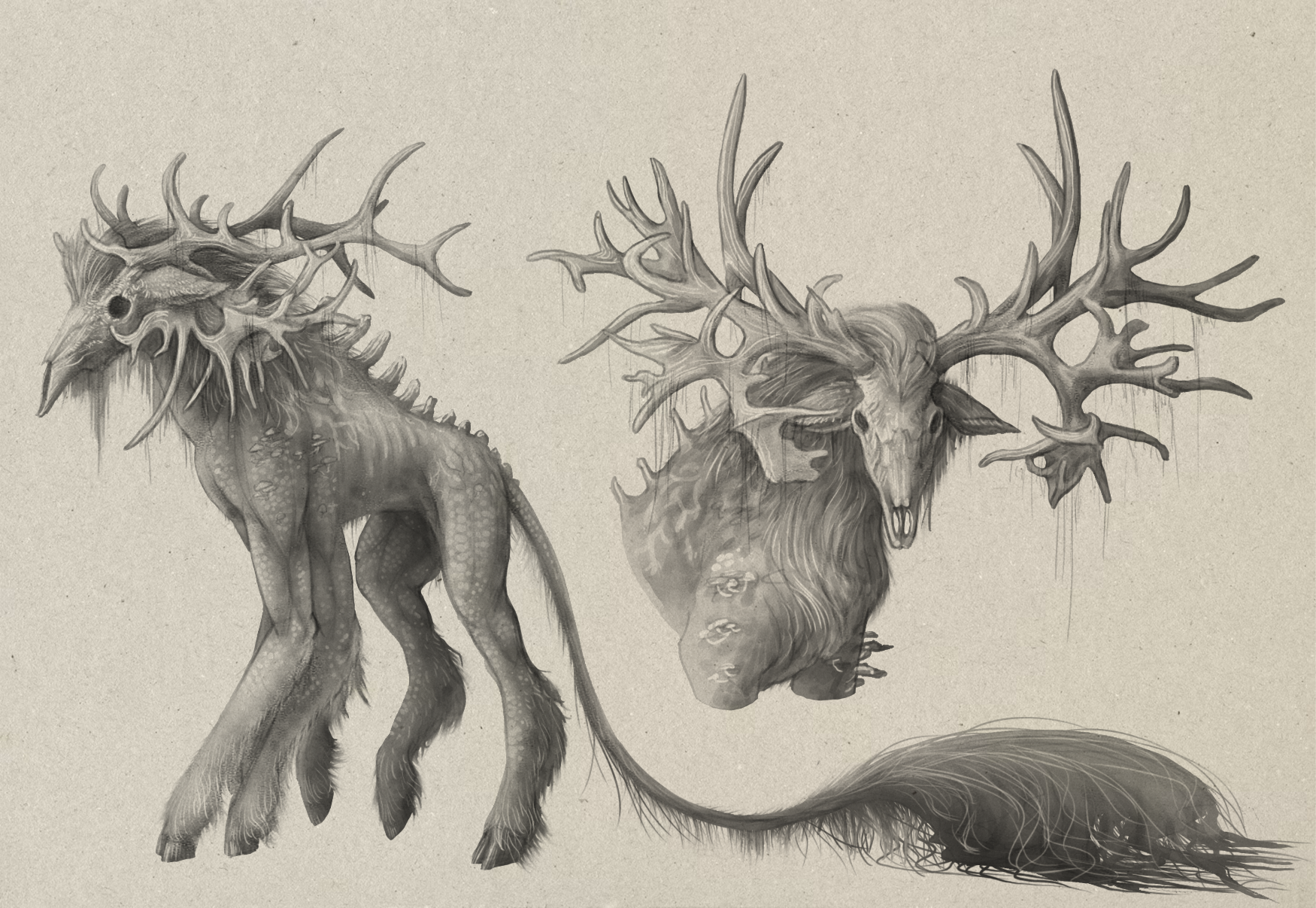
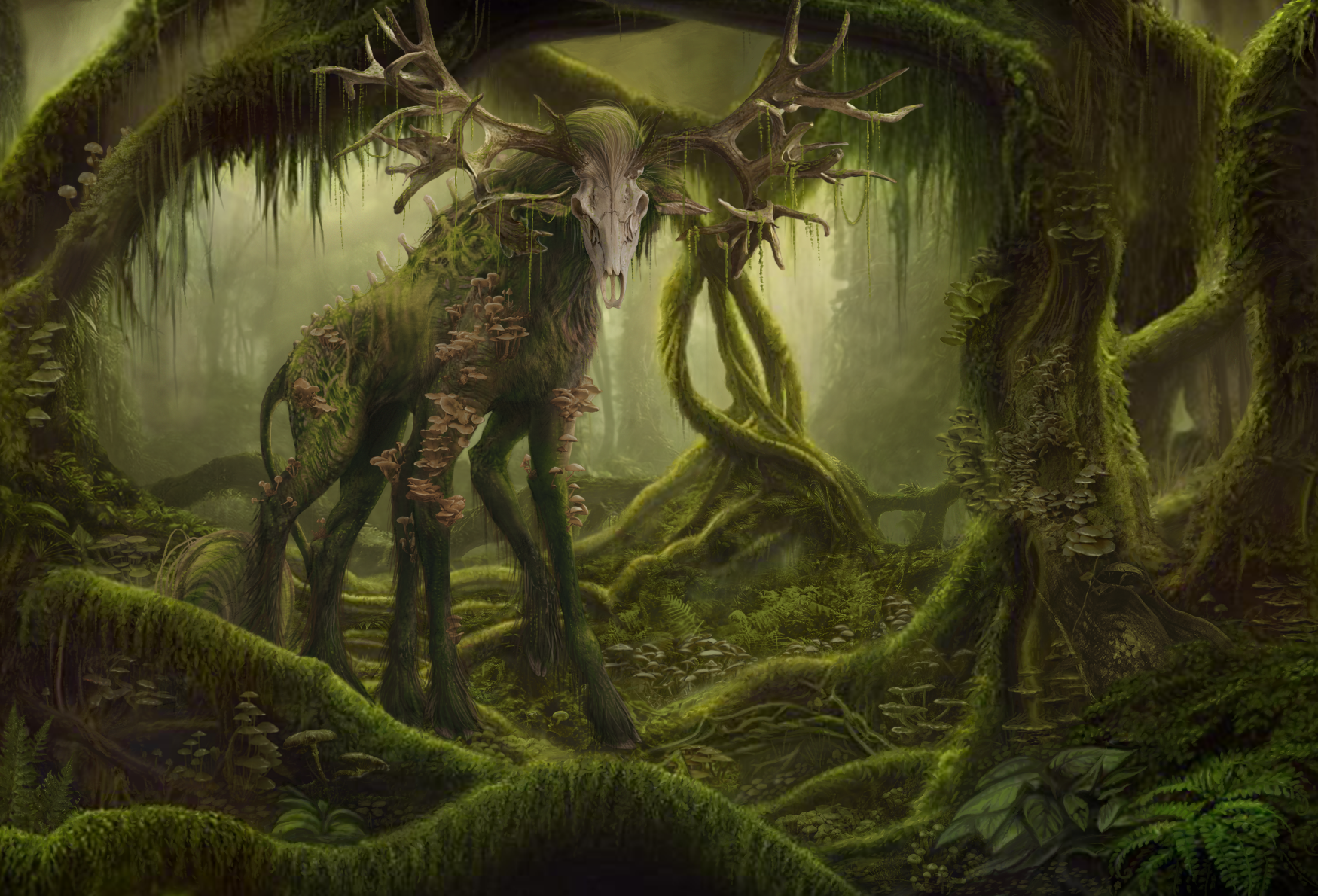
Kiiri is often depicted as a great, six-limbed deer with skin like leather and lichen, stitched by threads of mycelium. She is gaunt, universally associated with fungi, and always depicted with a crown of antlers. Her most prevalent symbol is that of a skull, draped in moss-laden hair. She does not speak to the living, yet it is said her breath smells of earth long disturbed. The faithful say she does not need words- for when she is near, the soul remembers what it was before the body.
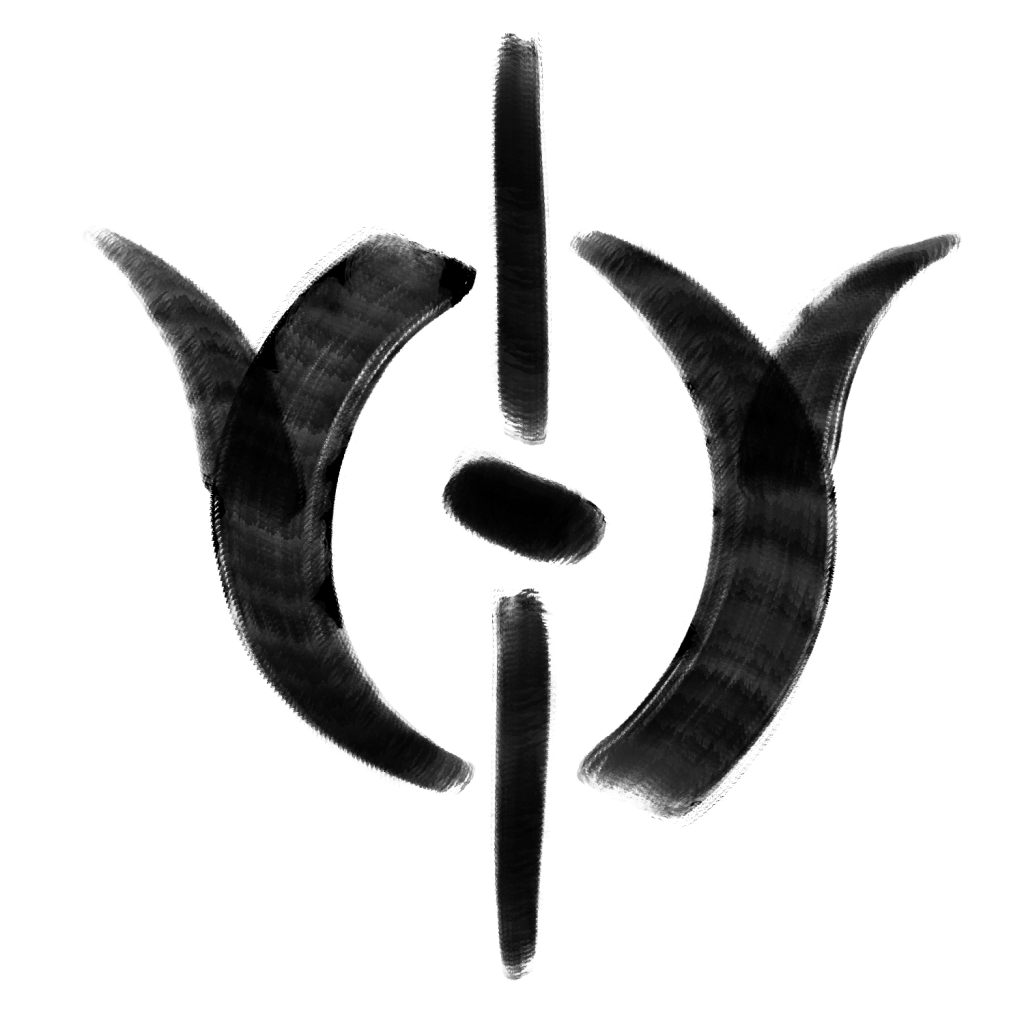
Kiiri’s symbol is drawn from a circle split by a vertical line, its center marked by a single dot, with twin curves branching upward from either side. The vertical line is the veil itself, that firm yet quiet boundary between life and death. The dot marks the threshold every soul must cross- the time and place where breath ceases, and the Ferrier waits to guide one’s passing. Together, the bisected circle and sweeping arcs resemble the crown of the Antlered One, spread in symmetry. They embody the truth of equal return: that death is not an ending, but the counterpart and completion of life itself. In this way, the mirrored design of Kiiri’s sigil reveals her nature: not as a destroyer, but as a keeper of balance.
Pantheon
Unlike Leje, who multiplies abundance outward, Kiiri draws all branches inward, toward stillness. Where other Greater Deities offer the miracle of beginnings, she offers the certainty of continuance: that nothing is wasted — not sorrow, not silence, not even the shadow of a passing breath. To her are sworn not only gods of ending lives, but also those of the hungers and fears that lead life to demise. The sickbed and the battlefield, the hush of a tomb and the whisper of a ghost — each has its steward beneath her crown. Her children do not reign over kingdoms, but over moments: the last sigh, the faltering heart, the bloom of rot beneath fallen leaves. To follow them is to know that death is not singular, but infinite, with as many faces as there are ways to live.
Aspected Deities
- Nabalel: Gods of Mysteries, The Veiled, and The Unknown
- Kyavu: God of Greed and Avarice
- Rilbuu: Goddess of Temperance
- Nats’ri: God of Immortality
- Zekii: Gods of The Unconscious
Vector Deities of Death
- Kii’ol: Gods of Stress
- Kivir: Goddess of Sickness and Infection
- Kii’krraa: God of Injury
- Kii’hruu: God of Hunger and Starvation
- Kii’mou: Goddess of Thirst and Dehydration
- Kii’fu: God of Asphyxiation
- I’ble: Goddess Parasites
- I’ea: God of Paralyzation
- I’na: Gods of Petrification
- Aezafep: Gods of Poison, Venom, and Toxin
- Aeshewis: Gods of Corruption and Wealth
- Aemotoi: Gods of War and Combat
Undead Sub-Pantheon
- Irshi: Goddess of Banshee
- Melindis: Gods of Ghosts
- Sain: God of Ghoul
- Veilshra: God of Liches
- Nubi: God of Mummies
- Erenyx: Goddess of Shadows
- Iup: God of Specters
- Culaita: Goddess of Spirits
- Gekeoua: Goddess of Wraith
- Abvalon: God of Vampires
- Codve: Gods of Zombies
Linear Deities of Death
- Hrakia or Hruuza: God of Denial
- Mukia or Muoza: Goddess of Rage
- Fukia or Fuza: God of Bargaining
- Lekia or Liza: Gods of Depression
- Kikia or Keza: Gods of Acceptance
- Saekia or Sa’za: Gods of Remembrance
- Gokia or Goza: God of Revenge
Cyclical Deities of Death
- Lelejeri: God of Rebirth
- Locoro: Gods of Corpses and Cadavers
- Nezari: Gods of Decay, Rot, and Bloat
- Hru’oli: Goddess of Fossils
- Aekilele: Gods of Echoes
Associated Deities
- Faje: Goddess of Breath
- Muje: Goddess of Blood
- Hroje: Goddess of Bone
- Microbial Sub Pantheon of Leje
- Fungal Sub Pantheon of Leje
- Multifaceted Gods of Emotion of Saeza
Myths and Legends
Mycelium of the Mothertree
It is said that interwoven with the grandeur of Ba’Lejel’s roots and branches lies the fungiform network of the Eternal Forest. The roots of the Mothertree are wrapped in endless mycelium — pale filaments that stretch into every grave, every fallen leaf, every forgotten bone. The living call it decay. The faithful call it return. For when a soul’s body falls, the mycelium reaches out, breaking it down not to end it, but to draw it back into the embrace of Kiiri. There, the air is hushed and the ground soft, pulsing faintly with the memory of countless lives. To step into that place is not to vanish, but to be welcomed — carried into a network without edge or ending. Each thread whispers, and together they form a chorus: of farmers and kings, of children and beasts, of all who have walked and rested. The faithful believe this is the gift of the Ferrier of All Who Were — that no soul is ever lost, but cradled in the mycelium, joined forever to the serenity of the forest that grows in silence.
Duty of the Duskwalkers
In the first age, Kiiri herself walked to meet every soul as it slipped from the mortal world. But as the years passed, the dead outnumbered the living, and the Eternal Forest could not be left unguarded. Worse still, the path between realms grew crowded, and some souls strayed into the dark — lost between breath and silence, never reaching the embrace that awaited them. Kiiri grieved these vanishings, and Leje grieved with her. So the Gods of Life shaped a gift: from the memory of Kiiri’s form, they guided life to bloom in her likeness. Thus came the Duskwalkers — flowing-maned, elegant-tailed, their eyes soft as twilight — charged as servants of the Ferrier. They walk the dusk of mortality, neither fully living nor dead, carrying the weight of a duty too great for one goddess alone. Now it is said that when a mortal’s time is spent, a Duskwalker appears at the edge of their sight — a shadow with patient eyes and a step as gentle as dimming daylight. To follow it is to find the Eternal Forest, and to enter Kiiri’s embrace without fear, guided home to the Ferrier of All Who Were.