True Neutral Greater Deity of Life
Gods of Day and Light; Titan of Dunes; Guardian of Knowledge and Keeper of Sentience; The Desert Dragon, The World’s Turtle, The Traveler, They Who Endure; The River’s Source, The Welcome Mirage, and Shepherd of Peasants, Slaves, and Lost Ones
Doctrine
Though often revered as a sort of creator deity, Leje does not hold this title. They are not the source of life, but its guardian and guide since it began. Life blooms not by force of will, but by the conditions they offer: water where there is none, light where no root should reach. Leje teaches that life is not a miracle of origin, but of permission– and even the wildest things grow if given room. All things that struggle, bloom, wander, or wither belong to them, for they are the gardener. They are generosity without promise, presence without pressure. Many worship Leje for what they can provide. Fewer recognize what they preserve- the right to fail, to falter, and to rest -for even the desert flowers where their footsteps linger.
Tenets of Faith
- Life is the Longest Story: Value persistence over glory. All things that live contribute.
- Those Who Wither Are Worthy: The lost, the low, and the overlooked- they are sacred.
- Grow What is Yours to Grow: You cannot turn day to night or shape the winds, but your roots, branches, and fruit are yours alone. Let your strength begin there.
- Roots Follow Water: Seek what sustains you, and plant yourself in it.
- Wisdom is Slow: Answers arrive in time. Let your thoughts weather before you speak.
Manifestations
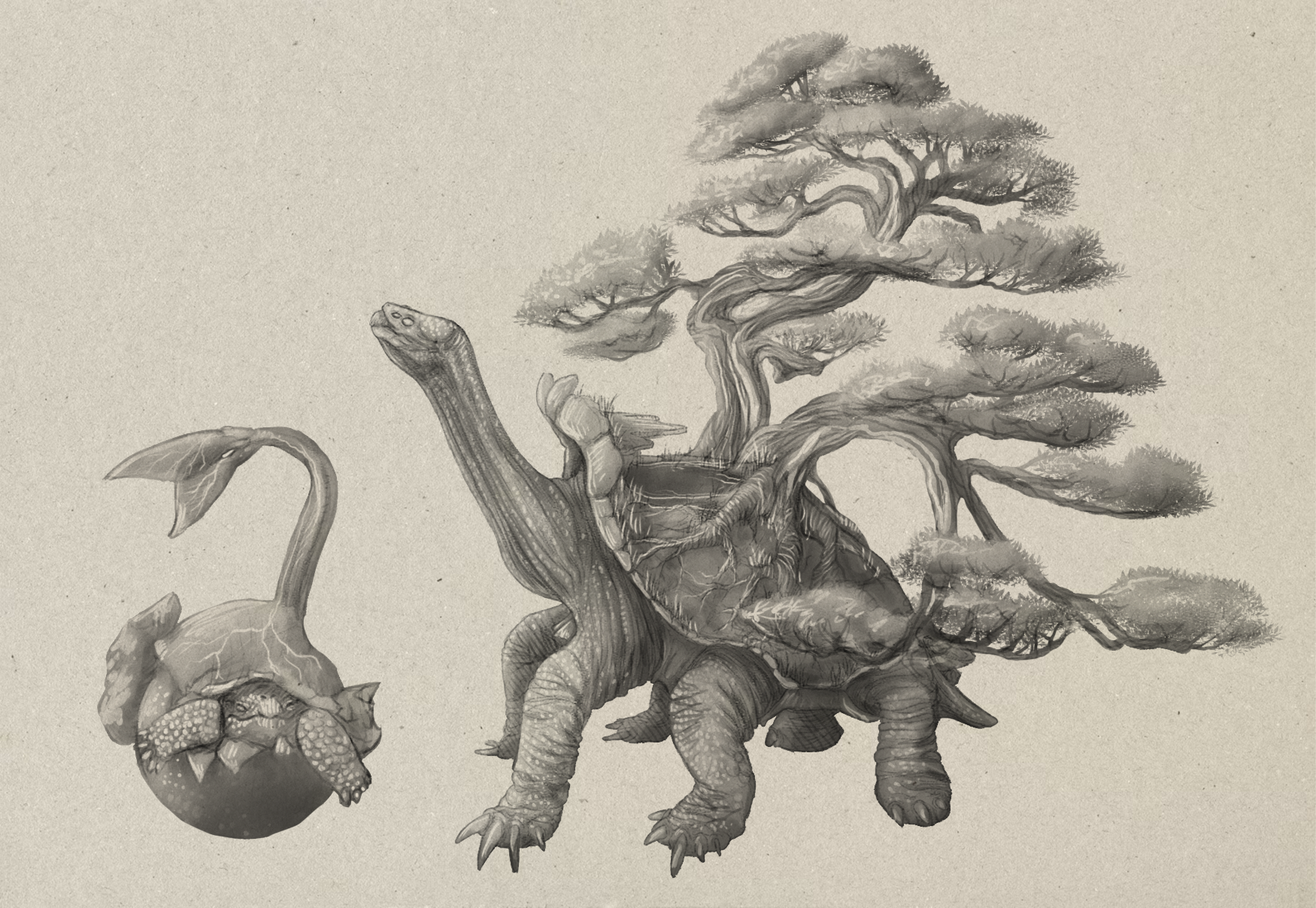
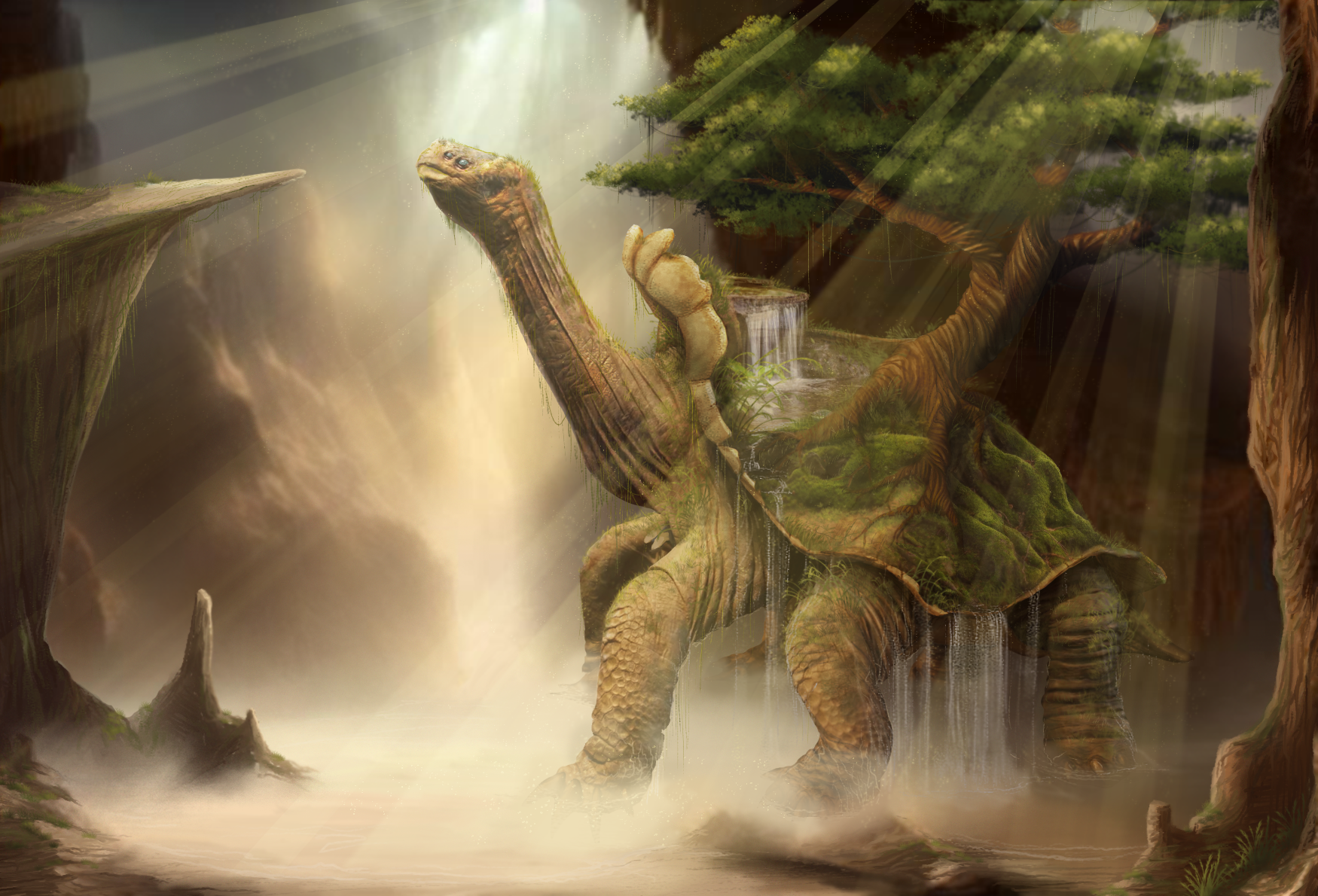
Leje is often spoken of as a vast tortoise — a six-legged titan whose shell is carved from ancient stone, etched in ever-changing runes. Upon their back grows Ba’lejel, the God of Knowledge, in the form of a towering tree whose roots are said to reach into memory itself. From the crest of their shell, it is said a spring flows: the fount of life. Some say the water tastes different depending on who drinks it- salt for the grieving, sweet for the joyful, bitter for the wise. They are said to wander the deserts alone, slow and silent, leaving no trail but the blessings that follow. The faithful tell of shade where none should be, water that pools without source, and oases blooming in their wake.
Leje’s symbol is formed from a branching line, a circle, and two dots. The line rises like a trunk and splits threefold, recalling Ba’lejel, the Mothertree, and evoking the radiant path of evolution. Each branch may be read as a stage of growth: seed, leaf, and bloom, or child, adult, and elder, all experienced in one life. The circle represents both canopy and shell: leaves gathered around Ba’lejel’s branches, yet also the curved carapace of Leje, the World’s Turtle, upon whose back life itself is carried. At the base, two mirrored dots remain a subject of debate, though most agree they signify the twin essences—plant and animal—joined together in one enduring form.

Pantheon
Leje is the parent to the largest subpantheon in the known realms of Alekia — a vast and tangled root system of divine lifeforms stretching from viruses and algae to dragons, mammals, and mythical beasts. As the steward of all living things, Leje does not hoard their power, but lets it proliferate — sprouting into deities that watch over every branch of the tree of life. While some gods rule domains or elements, Leje rules continuity — and from that, the tapestry of creation unfurls in overwhelming abundance. Each creature, from plankton to phoenix, is granted a guardian in Leje’s name, and each priest of their faith may find devotion anywhere life persists. The faithful say it is not proof of Leje’s ego, but their humility — for they never claimed to rule life, only to walk beside it.
Aspected Deities
- Ba’leyel: Gods of Knowledge, The Primordial Library, The Mother Tree
- Lehro: Goddess of Lust
- Yeythou: God of Chastity
- Ts’ri: God of Mortality
- Zele: Gods of the Conscience
Associated Deities
- Faje: Goddess of Breath
- Muje: Goddess of Blood
- Hroje: Goddess of Bone
Microbial Sub-Pantheon
- Nai’vir: Gods of Viruses
- Nai’baec: Gods of Bacteria
- Nai’baearch: Gods of Archaea
Fungal Sub-Pantheon
- Myask: Gods of Sac Fungi
- Basid: Gods of Gill Fungi
- Lomer: Gods of Tree Fungi
Faunal Sub-Pantheon
- Ea’didaera: Gods of Sponges and Corals
- Pololia: Goddess of Sea Jellies
- Kaiwanaloli: Gods of Sea Stars
- He’e Mauli: God of Mollusks
- Lehesale: Goddess of Brachiopods
- Schyla: Goddess of Worms
Muthouan Sub-Pantheon
- Na’ja: God of Lampreys and Hagfish
- Ukle’ess: Goddess of Placoderms
- Hahalua: Gods of Sharks, Rays, and Chimaeras
- Malolo: Gods of Coelacanths
- Allu: Goddess of Eels
- Ioka: Gods of Freshwater Baitfish
- Silu: God of Catfish
- Amotri: Goddess of Salmon, Pike, and Trout
- Makiawa: Gods of Oceanic Baitfish
- Ka I’a: Gods of Reef Fish
- Ahi: God of Tuna
- A’u Lepe: God of Sailfish
- Paki’i: God of Flatfish
- Lainihi: Goddess of Wrasse and Perch
- Lio Makani: Gods of Seahorses and Seadragons
- Muwea: Goddess of Deepfish and Mawfish
Featherfolk Sub-Pantheon
- Favui: God of Ever Fliers
- Faeivu: Gods of Cross Wings
- Coatl: Goddess of Amphitheres
- Arxi: God of Gryphons
- Aaxri: God of Hippogriffs
- Rrovu: Goddess of Cocatrice
- Tamepe: God of Chimeras
- Fabuu: God of Rocs
Floral Sub-Pantheon
- Glaeu: Gods of Algae
- Byoph: Goddess of Moss
- Monoph: God of Grass
- Paipo: Goddess of Ferns
- Caica: God Cycads and Palms
- Pin: Gods of Conifers
- Gin: Gods of Ginkgos
- Fin: Gods of Flowers
- Fon: Gods of Fruit
Athropleuran Sub-Pantheon
- Athropleur: Goddess of Centipedes
- Hexiin: Goddess of Insects
- Ulybdis: God of Scorpions
- Arrax: Goddess of Spiders
- Papaikualoa: God of Crustaceans
- Tillio: God of Trilobites
Rung Sub-Pantheon
- Kroquoui: Goddess of Frogs and Toads
- Urodela: God of Salamanders and Axolotl
- Na’oua’a: Gods of Nowoerms
Scalefolk Sub-Pantheon
- Yuoibea: Goddess of Snakes
- Rroibea: God of Lizards
- Leibea: Gods of Turtles
- Sobek: Gods of Crocodiles
- Nahesa: Goddess of Wyrms
- Draco: God of Drakes
- Saurex: Gods of Dinosaurs
- Quetzal: God of Pterosaurs
- Wivrys: God of Wyverns
- Dracrys: God of Dragons
Furfolk Sub-Pantheon
- Gemenae: Gods of Burrowers
- Faasae’i: Goddess of Night Fliers
- Ikimi: Goddess of Tree Keepers
- Kairae: God of Hoof Springers
- Taitia: God of Behemoths
- Kaoung: Gods of Primates
- Roou: Gods of Marsupials
- Baelaen: God of Aquatic Mammals
Myths and Legends
The Footsteps of Leje
It is said that Leje wanders the Tertials Desert not to lead, but to leave behind. Where their six great limbs press into the dunes, the ground softens, and the spring upon their back spills downward. When their foot lifts, what remains behind is not just water, but possibility. Every oasis — every hidden bloom, every stubborn grove of palms — is believed to have been born of such a step. Some are shallow pools where wanderers find shade and survive. Others have grown into entire communities, built unknowingly within the impressions of Leje’s passing. The devout call them the Oatstles — not oases, but footprints. To this day, when one crosses a dune and sees the impossible glint of water, they whisper, Leje has passed here.
The Lost Library of Ba’Lejel
The tree that grows upon Leje’s back is not only a living god — it is a library. Called Ba’Lejel, the Mothertree, it is said to contain every living thought that has ever passed through a sentient mind. Some stories say Leje once slumbered too long beneath the desert’s sun, and in that stillness, a grove of trees like Ba’Lejel sprouted and spread. When Leje woke and moved again, the forest was left behind. Those trees, no longer nourished by divine breath, calcified — their trunks turned to amber and stone, their branches forming endless corridors of fossilized bark. Hidden somewhere in the Tertials, this Lost Library is said to endure still — a labyrinth of wisdom petrified by time. Those who seek it rarely return. Those who do speak in whispers, having learned truths they cannot forget and can barely survive.