CONTENTS
XEVAN GALAXY
The Xevan Galaxy is home to the Ts’olan System, and in turn Alekia itself. It is more commonly referred to as The Eternal Library, with this name describing the galaxy’s appearance from Alekia: a hazy band of light seen in the night sky emanating from the constellation of the Gods of Life and Knowledge, Leje and Ba’leyel. The stars in this region are so numerous and dense from the Alekian perspective that they cannot be individually distinguished by the bare sight of any known race. Galaxio of Taoul di Orn first resolved the band of light into individual stars with his telescope in 1,656,383 A.C.. Until the arrival of the New Races at the turn of the Eon of New Realms, most astronomers thought the Eternal Library contained all the stars in the Realm.
Form and Structures
The Eternal Library is a spiral-shaped galaxy estimated to contain between one hundred and four hundred billion stars, and at least that number of planets. Its form consists of three major features: the Heart of the Library, the Galactic Disk (including both nebulae arms), and the Halo of Na.
The Halo of Na is a roughly spherical orb of unseen material which theoretically contains the remaining visible features of the Xevan Galaxy. It was hypothesized in 1,658,839 A.C. by Vidente Eek’o’obo’, when she observed an unexpected light-bending phenomenon at the edge of the Velanan Galaxy, Xevan’s closest cosmic neighbor.
The Heart of the Library, more academically titled the Galactic Center, includes the midpoint of all spacetime within the Xevan Galaxy. As the innermost portion of our galaxy, it boasts the densest concentration of stars and forms a bulge of interstellar media. These objects are considered the eldest stellar bodies among the Xevan Galaxy and fall neatly into the classification of population i stars having fewer heavy metals than Alekia’s star, Ts’ol.
The Galactic Disk is the accretion of stars and other interstellar media which rotate around the galactic center along a plane. At their origin at the Xevan Galaxy’s core, these bands of dense stellar concentration or ‘galactic arms’ have a linear, bar-shaped structure which extends outward and then merges into a spiral with logarithmic curls. This pattern can be theoretically shown to result from a disturbance in a uniformly rotating mass of stars, yet these bands appear to revolve with constant angular velocity.
THE TS’OLAN SYSTEM
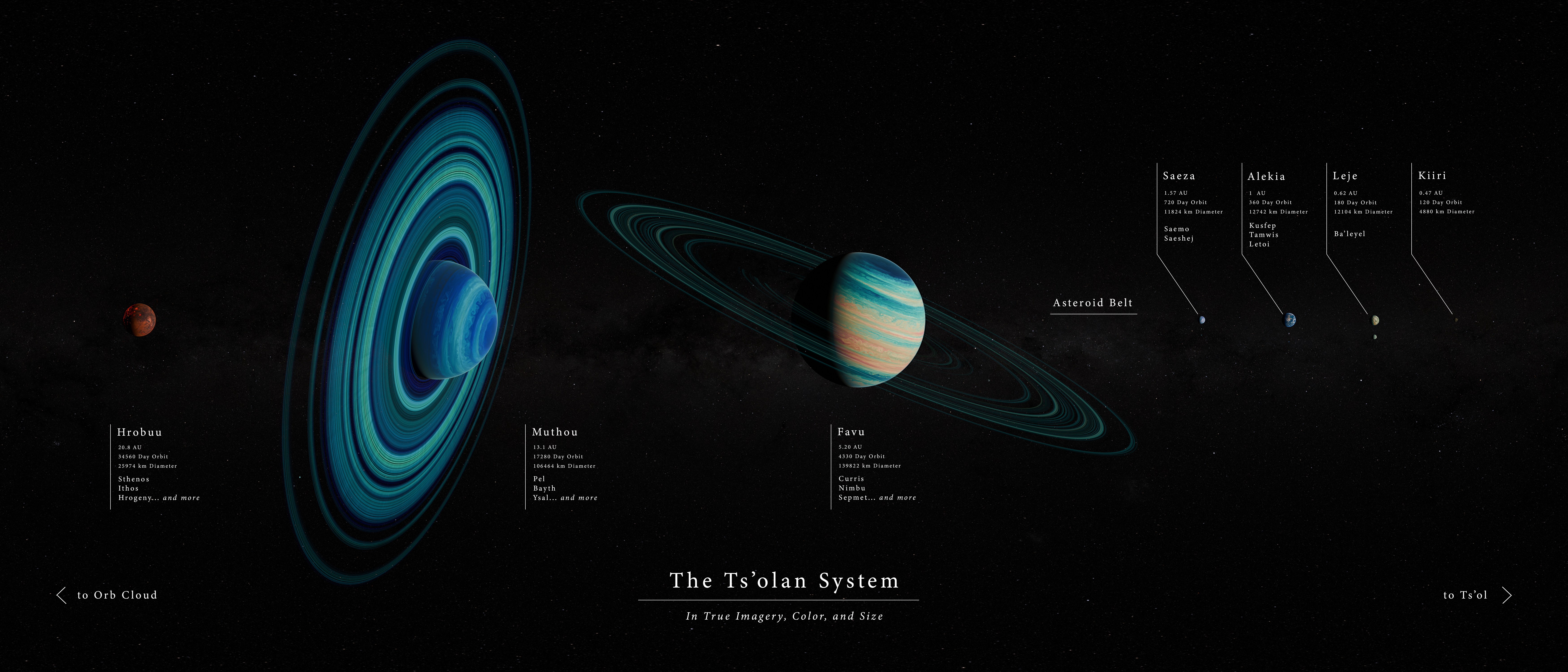
The Ts’olan System is the gravitationally bound system of Alekia’s star, Ts’ol, sometimes called ‘the sun’, and the objects that orbit it. It is still contested exactly when it formed, but there is consensus it occurred over three million years ago when a dense region of a molecular cloud collapsed, forming Ts’ol and a protoplanetary disk. Ts’ol is a typical star in that it maintains a balanced equilibrium by fusing hydrogen into helium within its core and releasing this energy from its outer photosphere.
The largest objects to orbit Ts’ol are an asteroid disc field, the hypothesized Orb Cloud, and seven planetary systems. In order from Ts’ol, these seven systems are- the four rocky, Kiiri, Leje with Ba’leyel, Alekia, and Saeza; gas giant, Favu; ice giant, Muthou; and chthonian giant, Hrobuu.
There are a vast number of small Ts’olan System bodies, such as asteroids, comets, phasers, meteoroids, and interplanetary dust clouds. Some of these bodies are in the asteroid belt between Saeza’s and Favu’s orbits, and others are assumed to concentrate closer to the Orb Cloud.
The Ts’olan System is constantly flooded by the star’s charged particles, which form the heliosphere. Nearing one hundred Alekian Units from it, this wind is halted, resulting in the heliopause; this is the boundary of the Ts’olan System to interstellar space. The outermost region of the Ts’olan System is the theorized Great Orb Cloud, the source for long-period comets, extending to an unknown distance beyond. It is believed light from the closest star, Et Jotunheim, takes over four Alekian years to reach the Ts’olan System. Both stars are located in the same band of the Xevan Galaxy.
THE SUN: TS’OL
Ts’ol is Alekia’s sun, and is by far its most massive component of the Ts’olan System. Its large mass (about 332,900 Alekian masses), which comprises a hypothesized over 99.8% of all mass in the Ts’olan System, produces temperatures and densities in its core high enough to sustain nuclear fusion of hydrogen into helium. This releases an enormous amount of energy, mostly radiated into space as electromagnetic radiation, peaking in visible light and temporal magic.
Along with light, Ts’ol radiates a continuous stream of super-charged particles known as Fa’eaza di Ts’ol or ‘tsolan winds’ in common. These particles are elevated beyond solid, liquid, or gaseous state to a form of matter most often referred to as simply: Pure Ea. This stream spreads outwards at speeds from slightly under one million to nearly two million kilometers per hour, filling the vacuum between bodies of the Ts’olan System known to many by its Alekian name: Na.
Conflicting Theories of Formation and Evolution
Currently, Ts’ol exists near the centerline of one of the Xevan Galaxy’s spiral arms, and it is assumed to have formed in this location due to the comparatively stable system orbits which revolve around it.
From this established baseline, it has been theorized by some Celestial graduates of Karuqa’s Academy of Ts’olanology and Cosmochronology that Alekia’s sun is a population ii star. This is to say, it has a higher abundance of elements heavier than metals than older population i stars in the galactic bulge and halo of the Eternal Library. Elements heavier than hydrogen and helium were formed in the cores of ancient and exploding stars, so the first generation of stars in the Alekian Universe had to die- perhaps tens of millions or even billions of years prior to the present -before the realm could be enriched with these atoms. The oldest stars contain few metals, whereas stars born later have more. This higher metallicity is thought to have been crucial to Ts’ol’s development of a planetary system because the planets formed from the accretion boast complex metallic compositions.
This hypothetical process of the life progression of the Alekian Universe, referred to as the Labored Realm Model, directly conflicts with divine histories honored and maintained by the First Peoples of Alekia. They stringently adhere to what is officially referred to as the Instant Realm Model, in which they theorize a rate of universal development which has thus been proven impossible by physical and mortally magical means. The Aurix Kalur Academy of Chronology recognizes both the Labored and Instant Realm Models as presently contending theories, though this may be a case where politics directly influence scientific perspective.
ASTEROID RINGS
The asteroid rings are a series of torus-shaped regions in orbit around Ts’ol which are distinguished into two greater segments. Both segments contain tens of thousands, potentially millions, of objects over one kilometer in diameter. Despite this, the total mass of the Rings is unlikely to be more than a thousandth that of Alekia, as the asteroid rings are very sparsely populated.
The segment closer to Alekia known as the Inner Asteroid Ring and is located between 2.3-3.3 Alekian Units from Ts’ol, and lies between the orbits of Saeza and Favu. It is thought to be remnants from the Ts’olan System’s formation that failed to coalesce due to the gravitational interference of Favu.
The further segment of the asteroid orbits, called the Outer Asteroid Ring, lies beyond the orbit of Hrobuu at more than 20 Alekian Units from Ts’ol, possibly extending to or beyond 150 AU from Ts’ol). It has similar debris to the inner asteroid belt, but consists mainly of objects composed primarily of ice. This region is still largely unexplored, and it appears to consist overwhelmingly of many thousands of small worlds- the largest having a diameter only a fifth that of Alekia and a mass far smaller than that of Kusfep -composed mainly of rock and ice. This region is sometimes described as the “third zone of the Ts’olan System”, enclosing the inner and outer planetary systems.
Below is a list of the largest bodies in the asteroid rings. They are all considered to be relatively intact protoplanets, a precursor stage before becoming a fully-formed planet.
Asteroids
Asteroids are classified as small Ts’olan System bodies and are composed mainly of carbonaceous, refractory rocky, and metallic minerals, with some ice. They range from a few meters to hundreds of kilometers in size. Many asteroids are divided into asteroid groups and families based on their orbital characteristics, and some asteroids have natural satellites that orbit them, that is, asteroids that orbit larger asteroids.
Meteors
Solid objects smaller than one meter are usually called meteoroids and micrometeoroids, with the exact division between the two categories being debated over the eras. Some formed via the disintegration of comets and asteroids, while a few formed via impact debris ejected from planetary bodies. Most meteoroids are made of silicates and heavier metals like nickel and iron. When passing through the Ts’olan System, comets produce a trail of meteoroids; it is hypothesized that this is caused either by vaporization of the comet’s material or by simple breakup of dormant comets. When crossing an atmosphere, these meteoroids will produce bright streaks in the sky due to atmospheric entry and are then called meteors. If a stream of meteoroids enter the atmosphere on parallel trajectories, the meteor will seemingly ‘radiate’ from a point in the sky, hence the phenomenon’s name: meteor shower.
Phasers
The phasers are icy comet-like bodies whose semi-major axes are greater than Favu’s and less than Hrobuu’s. These are former outer asteroid ring and scattered disc objects which were gravitationally perturbed closer to Ts’ol by the outer planets, and are expected to become comets or get ejected out of the Ts’olan System. While most phasers are inactive and asteroid-like, some exhibit clear cometary activity because they develop a coma just as comets do when they approach Ts’ol. The largest known phaser, 0697 Maeha, has a diameter of about two hundred and fifty kilometers and is one of the only few minor planets known to possess a ring system.
THE ORB CLOUD
Comets
Comets are small Ts’olan System bodies, typically only a few kilometers across, composed largely of volatile ices. They have highly eccentric orbits, generally a perihelion within the orbits of the inner planets and an aphelion far beyond Hrobuu. When a comet enters the inner Ts’olan System, its proximity to the central star causes its icy surface to sublimate and ionize, creating a coma: a long tail of gas and dust often visible to the naked eye from Alekia’s surface.
Comets are named for their color or after the individual who first observed and described them. The most studied are as follows:
- Red Comet
- Green Comet
- Gold Comet
- Galaxio’s Comet
- Buibui’s Comet
- Kel’eembal’s Comet
Short-period comets have orbits lasting less than two hundred years, while long-period comets have orbits lasting thousands of years. The former are thought to originate in the outer asteroid ring, whereas long-period comets are thought to originate in the outer asteroid ring or the Great Orb Cloud. Many comet groups formed from the breakup of a single parent. Some comets with hyperbolic orbits may originate outside the Ts’olan System, but determining their precise orbits is difficult. Old comets whose volatiles have mostly been driven out by solar warming are often categorized as asteroids.
The Great Orb Cloud
The Great Orb Cloud is a theorized spherical shell of up to a trillion icy objects that is thought to be the source for most long-period comets. No direct observation of this orb is possible with present magic technology. It is theorized to surround the Ts’olan System at roughly fifty-thousand AU and possibly as far as one-hundred thousand. It is thought to be composed of comets that were ejected from the inner Ts’olan System by gravitational interactions with the outer planets. Orb cloud objects move very slowly, and can be perturbed by infrequent events, such as collisions, the gravitational effects of a passing star, or the galactic tide- the name given to the force exerted by the Xevan Galaxy as it traverses True Na.
Much of the Ts’olan System is still unknown. Areas beyond thousands of AU away are still virtually unmapped and learning about this region of the realm is difficult. Study in this region depends upon inferences from those few objects whose orbits happen to be perturbed such that they fall closer to Ts’ol, and even then, detecting these objects has often been possible only when they happened to become bright enough to register as comets. Many objects may yet be discovered in the Ts’olan System’s uncharted regions.
ROGUE OBJECTS
A rogue object is a conglomerated interstellar mass which is not gravitationally bound to any star or does not follow the broader acceleration or velocity of the Galactic Disk. They may be planets, asteroids, or entire stars and are believed to originate from systems of gravitational accretion in which they formed and were later ejected. Alternatively, it is hypothesized rogue objects may form on their own, outside a planetary or tsolan system. It is possible these rogue objects can in turn, interact with otherwise relatively stable tsolan systems, resulting in their orbital perturbation. As an additional note, it is also possible one such disrupted tsolan system could be our own, but the vastness of the realm lends comfort in the unlikeliness of this scenario.
Go’terinimo
Otherwise known as the Void Star, Go’terinimo is perhaps the most perplexing body thus observed in the Alekian Heavens. As a bright stellar-like object, it has long been observed by countless Alekians, both astronomers and commoners alike, but recent observations call into question if Go’terinimo is truly stellar. It sits between constellations Ershejox and The Barbarian as one of the brightest objects in the night sky. Though noted by generations, none have written more on this object than the infamous Elven astronomer, Jandrei Niflem.
More commonly known as the Mad Stargazer, Niflem is attributed to writing the first official description of Go’terinimo in 1,655,426 A.C., “a distinctly azure star with peculiar stillness in the Heavens.” Indeed, the object is widely known for its reliable location at the fifteenth degree parallel north of the equator. Three centuries after this first observation, Jandrei continued to note the stellar-like object singularly and persistently, “I am to theorize its minimal lateral trajectory must be due to relative movement of our Ts’olan bodies.” Niflem continued her work through the end of her life. However, she is noted by several physicians to have suffereda steady cognitive decline as her age surpassed comprehensive natural or magical means. According to one caregiver, Niflem developed ‘an obsessive form of worship to some personification of Go’terinimo’. The final entry of her workbook- near a millennium later -reads, “Their stillness increases in earnest, and I fret to must conclude They are nigh. Na be merciful.” Much of Jandrei Niflem’s work has been officially rejected by the Astronomers of Aurix Kalur. However, recent reinterest on the object in a youth cultural phenomenon led to serious discovery with a small team of understudy graduates at Karuqa’s Crossing University. Against school policy and after hours, several members of the academic club ‘Sky Spotters,’ pointed the recently completed megatelescope G.W.A.A. towards Go’terinimo. What they saw and described not only prevented their expulsion but secured a note in recent history. Below is an excerpt from their school paper The Squawk, as printed on Makt Baxox 1, 1,658,842 A.C., translated from Auran.
“Yea, we had to wait to open the skylight until we knew we had the thing positioned so as to not get caught. We were all nervous, but giddy: laughing. I was confused when as soon as each of them looked they turned silent. By my glance I understood why. Everyone knows stars glow; they are domains of Ts’ol which burn Pure Ea- but Go’terinimo has a void in its heart.”